
-
IIMB Archives
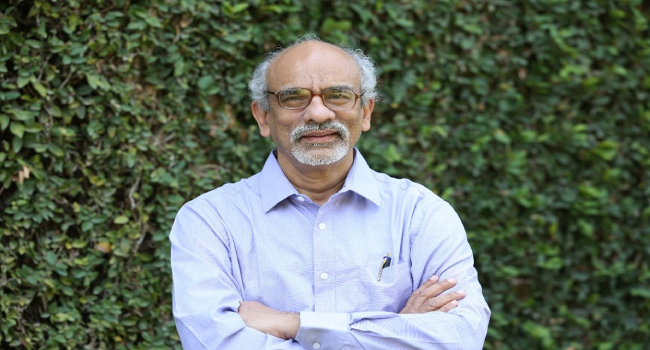
Professor G. Raghuram holds a BTech from IIT Madras; a Post Graduate Diploma in Management from IIM Ahmedabad (IIMA); and a PhD from Northwestern University, USA. Prior to taking over as Director of IIM Bangalore, he was Professor and Chairperson of the Public Systems Group at IIMA. He has been Dean (Faculty) at IIMA, Vice-Chancellor of the Indian Maritime University, and Indian Railways Chair Professor at IIMA.
The honours and recognitions awarded to Professor G. Raghuram include (i) Life-time Achievement Award for Transport Excellence, by Mahindra and Mahindra, supported by Ministry of Road Transport and Highways in 2018 (ii) MC Puri Memorial Award for contribution to Operational Research in India in 2016 (iii) Lifetime Achievement Award for contribution to Logistics and Infrastructure by EXIM News in 2014 and (iv) Academician of the Year by the Chartered Institute of Logistics and Transport in 2012. He is a Fellow of the Operational Research Society of India, and Chartered Institute of Logistics and Transport. He has teaching experience at universities in India, USA, Canada, Yugoslavia, Singapore, Tanzania, UAE, and Japan.
Professor G. Raghuram’s academic specialization lies in production & operations management; transportation and infrastructure systems; public policy and regulatory systems; and logistics and supply chain. Associated with the Public Policy area at IIM Bangalore, Professor Raghuram’s profile reflects a distinctive integration of operations, infrastructure economics, and governance frameworks. His scholarship bridges business, government, and infrastructure policy, examining how logistics systems, regulatory institutions, and public sector reforms influence economic competitiveness. His work situates management education within broader questions of public systems efficiency and national development.
During his tenure as Director, IIMB strengthened its engagement with national policy initiatives and global academic networks, aligning institutional priorities with India’s evolving economic landscape.
Professor Raghuram was closely associated with initiatives relating to digital transformation, infrastructure policy, and the transition to degree-granting authority following the enactment of the IIM Act. His academic grounding in infrastructure and regulatory systems informed his approach to institutional reform, emphasizing structural clarity, governance autonomy, and long-term sustainability.
He headed a visioning exercise with significant faculty involvement and interactions with the Board, and the vision document emerged in 2017 with the Institute adopting the vision: To be a global, renowned academic institution fostering excellence in management, innovation and entrepreneurship for business, government and society.
Professor Raghuram has taught across programs including the Post Graduate Program (PGP); Executive Post Graduate Program (EPGP); Doctoral/FPM; and Executive Education programs. Across these programmes, his courses have reflected analytical rigour combined with policy relevance, particularly in transportation systems, infrastructure strategy, and regulatory design. IIMB’s executive education portfolio remained robust under his leadership, with over 200 programs annually serving more than 6,000 participants. These programs spanned open enrolment, customized corporate offerings, and sector-focused public policy engagements.
The Institute’s flagship two-year MBA (PGP) and one-year MBA (EPGP) maintained strong global rankings during this period, reinforcing IIMB’s reputation for academic excellence. Simultaneously, IIMB expanded its digital footprint. By 2016–17, the Institute had emerged as India’s largest MOOC-offering business school, with significant outreach through edX and blended-learning platforms. This digital foundation continued to strengthen during Professor Raghuram’s tenure, reflecting his recognition of technology-enabled learning as central to future-ready management education.
One of Professor Raghuram’s consequential contributions was steering IIMB through the implementation of the IIM Act. With the Act coming into place in January 2018, IIMB transitioned into a new institutional framework and began formally granting degrees instead of diplomas—a historic transformation in the Institute’s academic identity. On March 17, 2018, IIMB awarded degrees to its postgraduate students under this new mandate, marking a symbolic and structural shift in its status as a premier higher education institution.
Under Professor Raghuram’s leadership, IIMB:
The launch of the Business Analytics program reflected the growing centrality of data-driven decision-making in management education, while the NSR Pre-Doctoral Fellowship strengthened doctoral pipelines and research capacity. The Mahatma Gandhi National Fellowship further deepened IIMB’s engagement with public systems and grassroots governance.
Professor Raghuram also played a significant role in strengthening research centres and institutional frameworks. During 2017–18, four new centres and research interest groups were launched, including:
These initiatives expanded IIMB’s academic footprint in cross-cultural management, international collaboration, and communication research, and practices of teaching and learning. The Institute continued to expand its research dissemination and case-writing ecosystem, leveraging global partnerships and strengthening IIMB Management Review as a scholarly platform.
Professor Raghuram’s long-standing expertise in transportation and infrastructure has historically informed advisory roles at national and state levels. During his directorship, IIMB deepened engagement with national initiatives such as Make in India, Digital India, and Skill India, aligning management education and research with broader economic transformation goals. His policy-aware orientation ensured that IIMB’s academic agenda remained responsive to India’s infrastructural and regulatory challenges.
Professor Raghuram has contributed significantly to scholarship in infrastructure systems, public transportation – railways, port, shipping, aviation and road, and operations management. His research addresses regulatory reform, logistics efficiency, multimodal transportation, and institutional governance—areas critical to emerging economies seeking to balance growth with sustainability. His academic contributions exemplify the integration of analytical modelling, sectoral expertise, and policy engagement.
Professor Raghuram has been member of the Board of Directors of companies in the fields of infrastructure and logistics, and educational institutions. He has been part of various government policy making and advisory committees for the Ministries of Civil Aviation, Consumer Affairs and Public Distribution, Railways, Road Transport and Highways, and Shipping, the Cabinet Secretariat, the Comptroller and Auditor General, the Planning Commission and various State Governments.
Under his tenure, IIMB sustained its research profile and international ranking momentum, with strong performance in global MBA and executive education rankings. Faculty publications, research centre activity, and doctoral engagement continued to expand, reinforcing IIMB’s position as a research-led institution.
The reforms and activities initiated positioned IIMB strategically as it approached its Golden Jubilee milestone in 2023. Recognising the importance of institutional memory, Professor Raghuram initiated a formal history documentation project to chronicle IIMB’s evolution, ensuring that its legacy would be preserved for future generations. The institutional documentation initiative he championed reflected his belief that strong institutions require both forward-looking reform and careful preservation of their intellectual heritage
Professor Raghuram is considered to be a systems thinker—methodical, policy-aware, and institutionally grounded. His leadership style emphasized structural transformation over symbolic change, focusing on governance reform, academic autonomy, program expansion, and centre creation. His leadership combined academic seriousness with institutional stewardship, leaving IIMB structurally stronger, policy-aligned, and globally integrated at the close of his directorship in July 2020.
Link to an account of the launch of the IIMB Golden Jubilee publication, ‘The Evolution of IIMB: Directors’ Perspectives’
https://www.iimb.ac.in/archives/directors-perspectives.php
For more from “The Evolution of IIMB: Directors’ Perspectives”, which features interviews with former Directors Professors J. Philip, K. R. S. Murthy, M. Rammohan Rao, Prakash G. Apte and Sushil Vachani, and a foreword by the then Director Professor G. Raghuram, and an essay (reproduced from an earlier collection) by the first Director Professor N. S. Ramaswamy visit
https://www.iimb.ac.in/archives/directors-perspectives.php
Click to read the book : https://www.iimb.ac.in/sites/default/files/directors-perspectives/#p=1
Link to Interview with Professor G. Raghuram from the IIMB Archives’ Oral History Narratives
https://www.iimb.ac.in/archives/raghuram.php