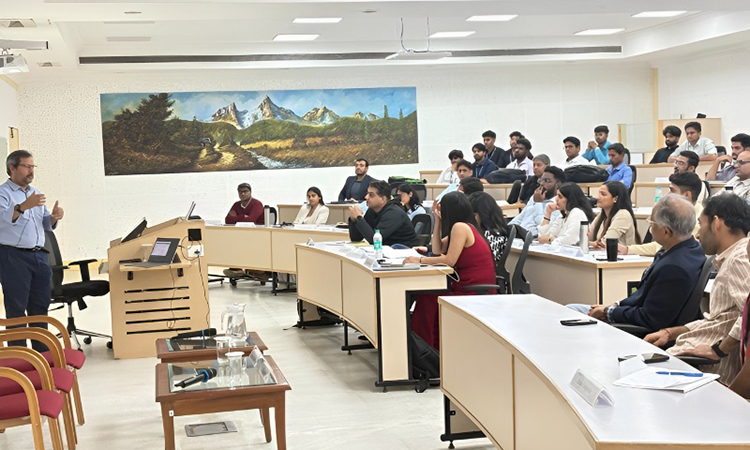
Talk saw the National Stock Exchange Chief Economist sharing an overview on India’s economic landscape, capital markets and long-term growth trajectory
1 December, 2025, Bengaluru: The Centre for Capital Markets and Risk Management (CCMRM) hosted a session – ‘Insights into the Market Pulse with Tirthankar Patnaik’, on 28th November 2025, at IIM Bangalore. Tirthankar Patnaik is the Chief Economist at the National Stock Exchange (NSE).
During the talk, he shared his perspective on current market dynamics, key economic trends shaping India’s financial landscape and the factors influencing investor behavior. The session offered a clear understanding of emerging risks, opportunities and structural shifts impacting the Indian economy and capital markets.
While sharing an insightful overview on India’s economic landscape, capital markets and long-term growth trajectory, he observed that India continues to maintain macroeconomic stability with a controlled fiscal deficit, even in comparison to advanced economies like that of the United States. “With a GDP of about ₹350 lakh crore and an equity market valued at approximately ₹460 lakh crore, India’s financial ecosystem has expanded significantly”, he added. He also highlighted that GST collections have doubled in recent years, reflecting growing formalization and improved compliance.
Mr. Patnaik emphasized on the demographic advantage India holds, with a median age of 28 years, considerably younger than countries such as China and Japan. “While India’s per-capita income is around 3,000 dollars compared to China’s 12,000 dollars, this wide gap indicates substantial long-term consumption potential.”
During the session, he explained how India has largely addressed the earlier twin balance sheet problem and is now seeing healthier corporate leverage along with strong bank credit growth sustained over the past four years. He also discussed the rapid evolution of India’s capital markets, underlined by the surge in retail participation. “The investor base, which remained limited for many decades, has expanded to an estimated 13.5 crore individuals today, including about five crore mutual fund investors. Daily trading volumes on NSE have reached nearly 30 crore trades, and India has become the world’s largest derivatives market. Digital adoption has also accelerated, with more than 20 percent of trades now happening through mobile devices, up from less than one percent in 2010.”
He pointed out that India has emerged as a global leader in services, hosting nearly half of the world’s Global Capability Centres. “At the same time, certain factors such as relatively high valuations, capital gains taxation and stringent regulatory frameworks influence foreign investor behavior. India currently does not have a major home-grown large language model at global scale, presenting a meaningful opportunity for future technological advancement.”
The lecture concluded with an optimistic view of India’s future. Mr. Tirthankar Patnaik highlighted that the combination of favorable demographics, deeper financialization, improved corporate health and rising digital participation positions India for sustained economic growth, even as the country continues to navigate structural reforms and global market perceptions.