
Mind over matter for effective management practice: Swami Mukundananda
Lecture ‘Manager – Manage Your Mind’ explores why spirituality remains central to modern organisational life
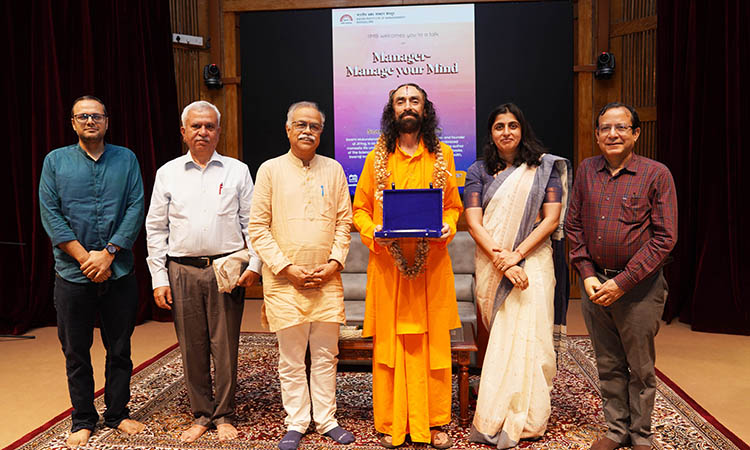
6 December, 2025, Bengaluru: Swami Mukundananda, spiritual teacher, author, and founder of JKYog, delivered a lecture titled ‘Manager – Manage Your Mind’ at IIM Bangalore, bringing to light the growing relevance of spirituality in leadership and professional practice. He drew on ideas from his book ‘The Science of Mind Management’ and related works to outline how inner machinations of the mind that involve discipline, thought, and self-awareness shape both personal well-being and managerial effectiveness.
The session was facilitated by Professor M Jayadev, Dean of Administration and faculty of Finance & Accounting, who welcomed Swami onto the dais.
Situating spirituality within the contemporary organisational context, Swami Mukundananda noted that institutions like IIM Bangalore cultivate professional competence, while spiritual inquiry deepens the purpose behind such effort. “In a sacred institution such as the IIMB, blessed by the divine Saraswati and enriched by the presence of stimulated intellects of the country, you learn how to manage; with spirituality, you learn why you must manage. It enriches your inner life”, he observed.
He described Spiritual Science as a “para vidya” that complements material and managerial knowledge by enabling individuals to cultivate four capacities essential for modern professionals: self-awareness, universal awareness, self-mastery, and professional mastery. In countering the misconception that spirituality requires a sense of withdrawal from professional life, he stated, “It is a misunderstanding that spirituality wants us to retire from the organisational arena. Professional mastery and the skill of making a difference in the lives of others through service are what spirituality teaches us”.
He later posed a question to the audience, saying, “Managers know to manage market environments, information systems, and personnel — but can we manage the mind?”, citing a study where a number of U.S. companies attributed the dismissals of 67% of the employees not to the lack of skillset but to a lack of the right mindset. He added that the pattern pointed to the inner conditions shaping decisions as being just as consequential as the decisions themselves.
A portion of the lecture was devoted to the mind’s tendency to mistake subjective perception for objective truth. “You don’t realise that the way you look at things is a subjective reality, but you convince yourself that it is the objective reality,” Swami observed, noting that the mind’s negativity bias often prevents individuals from stepping back and reassessing what they believe to be factual. The best way to guide the mind, he added, was by bringing useful pieces of knowledge into one's intellect.
He also noted that managing the mind requires recognising that, irrespective of circumstance, “you are always free to choose your thoughts”. When one becomes embittered or reactive, he suggested, the cause often lies not in the environment but in one’s own inability to examine the origins of those thoughts. Invoking Adi Shankaracharya’s saying, “Who shall conquer the world? The one who has conquered his mind”, he suggested that the marshalling of one’s inner resources – mind over matter – is the pathway to becoming “a better, happier and healthier person”.
During the Q&A part of the session, discussions explored the pressures of outcome-driven environments and the modern-day ubiquity of stress. Drawing on the Bhagavad Gita, he advised the audience on the wisdom of aligning effort with detachment, saying, “The problem with an outcome-oriented mindset is that it ties your happiness to an impending result. Plan diligently, give your best, and enjoy the effort”, without chasing external benchmarks.
Swami also responded to questions on values, resilience, and purpose, and urged participants to treat inner work with the seriousness accorded to professional advancement. “Be serious about the opportunity of life that God has given you – but not so serious that you forget to enjoy the fruits of life,” he said.
Mind over matter for effective management practice: Swami Mukundananda
Lecture ‘Manager – Manage Your Mind’ explores why spirituality remains central to modern organisational life
6 December, 2025, Bengaluru: Swami Mukundananda, spiritual teacher, author, and founder of JKYog, delivered a lecture titled ‘Manager – Manage Your Mind’ at IIM Bangalore, bringing to light the growing relevance of spirituality in leadership and professional practice. He drew on ideas from his book ‘The Science of Mind Management’ and related works to outline how inner machinations of the mind that involve discipline, thought, and self-awareness shape both personal well-being and managerial effectiveness.
The session was facilitated by Professor M Jayadev, Dean of Administration and faculty of Finance & Accounting, who welcomed Swami onto the dais.
Situating spirituality within the contemporary organisational context, Swami Mukundananda noted that institutions like IIM Bangalore cultivate professional competence, while spiritual inquiry deepens the purpose behind such effort. “In a sacred institution such as the IIMB, blessed by the divine Saraswati and enriched by the presence of stimulated intellects of the country, you learn how to manage; with spirituality, you learn why you must manage. It enriches your inner life”, he observed.
He described Spiritual Science as a “para vidya” that complements material and managerial knowledge by enabling individuals to cultivate four capacities essential for modern professionals: self-awareness, universal awareness, self-mastery, and professional mastery. In countering the misconception that spirituality requires a sense of withdrawal from professional life, he stated, “It is a misunderstanding that spirituality wants us to retire from the organisational arena. Professional mastery and the skill of making a difference in the lives of others through service are what spirituality teaches us”.
He later posed a question to the audience, saying, “Managers know to manage market environments, information systems, and personnel — but can we manage the mind?”, citing a study where a number of U.S. companies attributed the dismissals of 67% of the employees not to the lack of skillset but to a lack of the right mindset. He added that the pattern pointed to the inner conditions shaping decisions as being just as consequential as the decisions themselves.
A portion of the lecture was devoted to the mind’s tendency to mistake subjective perception for objective truth. “You don’t realise that the way you look at things is a subjective reality, but you convince yourself that it is the objective reality,” Swami observed, noting that the mind’s negativity bias often prevents individuals from stepping back and reassessing what they believe to be factual. The best way to guide the mind, he added, was by bringing useful pieces of knowledge into one's intellect.
He also noted that managing the mind requires recognising that, irrespective of circumstance, “you are always free to choose your thoughts”. When one becomes embittered or reactive, he suggested, the cause often lies not in the environment but in one’s own inability to examine the origins of those thoughts. Invoking Adi Shankaracharya’s saying, “Who shall conquer the world? The one who has conquered his mind”, he suggested that the marshalling of one’s inner resources – mind over matter – is the pathway to becoming “a better, happier and healthier person”.
During the Q&A part of the session, discussions explored the pressures of outcome-driven environments and the modern-day ubiquity of stress. Drawing on the Bhagavad Gita, he advised the audience on the wisdom of aligning effort with detachment, saying, “The problem with an outcome-oriented mindset is that it ties your happiness to an impending result. Plan diligently, give your best, and enjoy the effort”, without chasing external benchmarks.
Swami also responded to questions on values, resilience, and purpose, and urged participants to treat inner work with the seriousness accorded to professional advancement. “Be serious about the opportunity of life that God has given you – but not so serious that you forget to enjoy the fruits of life,” he said.