
CSITM at IIMB and AIS India Chapter inaugurate two-day workshop on ‘Scholarship in the AI Age’
Inaugural keynote address by Prof. Rahul Dé on ‘Beyond the Script: Performativity, GenAI, and the Shifting Stage of Scholarship’
January 22, 2026, Bangalore: The Centre for Software and IT Management (CSITM) at the Indian Institute of Management Bangalore (IIMB), in collaboration with the Association for Information Systems (AIS) – India Chapter, inaugurated the two-day workshop ‘Scholarship in the AI Age’ on January 22, 2026. The workshop brought together scholars, doctoral students, and educators to engage in critical, dialogue-driven discussions on how artificial intelligence is reshaping scholarship, research practices, and academic identity.
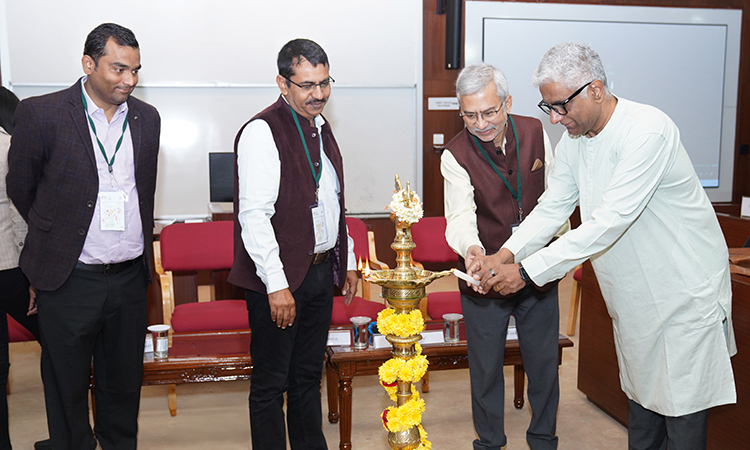
The workshop commenced with the ceremonial lighting of the lamp, followed by opening remarks from Prof. Mayank Kumar, Chairperson of CSITM at IIM Bangalore, who set the context for the deliberations by acknowledging both the opportunities and tensions surrounding AI in academia. “AI is increasingly embedded in teaching, learning, and research, yet its role in scholarship must be examined with care rather than accepted unquestioningly,” he observed.
Emphasising the need for reflective engagement, Prof. Kumar noted that the workshop aims to provide a platform for scholars to critically examine what constitutes legitimate, responsible, and meaningful use of AI, while preserving academic agency and the core values of scholarship.
Welcoming participants on behalf of the AIS India Chapter, Prof. Sujeet K. Sharma, President of the AIS India Chapter, Dean (Research), and Professor at IIM Nagpur, spoke about the chapter’s journey since its establishment in 2016 and its commitment to nurturing a vibrant scholarly community through workshops, conferences, and sustained collaboration. He encouraged participants to actively engage with peers and contribute to ongoing conversations beyond the workshop.
In the welcome address, Prof. Shankar Venkatagiri, Chairperson, Information Systems area, IIMB, emphasized the importance of a balanced approach to AI adoption. He advised scholars to rely on large language models for certain tasks while resisting the temptation to outsource critical thinking, interpretation, and intellectual responsibility.
Keynote Address: Beyond the Script: Performativity, GenAI, and the Shifting Stage of Scholarship
In his keynote address, Prof. Rahul Dé, Former Faculty, Information Systems area, IIMB, and Founder & CEO of Memoric AI, offered a critical and theoretically grounded examination of Generative AI’s growing role in academia. Framing scholarship through the lens of performativity theory, he conceptualised the academic as a performer operating on a scholarly stage, teaching, researching, and administering, while Generative AI increasingly assumes the role of a prompter: ever-present, influential, yet traditionally unseen.
Drawing on critical scholarship, Prof. Dé argued that the accelerating adoption of GenAI risks reinforcing an already problematic publish-or-perish culture, pushing academic research towards a “factory mode” characterised by speed, fragmentation, and instrumentalism. He cautioned that when publication metrics dominate academic evaluation, the use of GenAI becomes not merely optional but structurally incentivised, thereby reshaping scholarly practice in fundamental ways.
He highlighted three major risks associated with uncritical reliance on GenAI in scholarship. First, infantilisation, wherein scholars abdicate independent thinking and submit to the perceived authority of algorithmic outputs. Second, reductionism, which reduces faculty and students to predictable, tool-driven behaviours, eroding the intellectual struggle that traditionally shapes scholarly judgement. Third, totalisation, through which AI systems extend their influence beyond discrete academic tasks to shape identities, norms, and behaviours across all aspects of academic life.
Linking these concerns to Judith Butler’s theory of performativity, Prof. Dé argued that repeated reliance on AI-mediated practices does not merely assist academic work but actively constitutes scholarly identity. When the “prompter” begins to step onto the stage, he warned, the boundary between human judgement and machine guidance risks collapsing.
While acknowledging that GenAI use in scholarship is inevitable, and, in some contexts, necessary, Prof. Dé emphasised that responsibility, agency, and control must remain firmly with human scholars. He called for alternative paths forward, including collective resistance to excessive publication fetishism, renewed emphasis on problem-driven research, and deliberate efforts to protect spaces where human struggle, fallibility, and judgment are central to learning, particularly in doctoral education.
Concluding his address, Prof. Dé urged the academic community to celebrate human effort and discernment while consciously downplaying machine-assisted outputs. Reiterating the central metaphor of his talk, he reminded participants that while the prompter may assist, “the prompter must never come on stage.”
Click here for photo gallery
CSITM at IIMB and AIS India Chapter inaugurate two-day workshop on ‘Scholarship in the AI Age’
Inaugural keynote address by Prof. Rahul Dé on ‘Beyond the Script: Performativity, GenAI, and the Shifting Stage of Scholarship’
January 22, 2026, Bangalore: The Centre for Software and IT Management (CSITM) at the Indian Institute of Management Bangalore (IIMB), in collaboration with the Association for Information Systems (AIS) – India Chapter, inaugurated the two-day workshop ‘Scholarship in the AI Age’ on January 22, 2026. The workshop brought together scholars, doctoral students, and educators to engage in critical, dialogue-driven discussions on how artificial intelligence is reshaping scholarship, research practices, and academic identity.
The workshop commenced with the ceremonial lighting of the lamp, followed by opening remarks from Prof. Mayank Kumar, Chairperson of CSITM at IIM Bangalore, who set the context for the deliberations by acknowledging both the opportunities and tensions surrounding AI in academia. “AI is increasingly embedded in teaching, learning, and research, yet its role in scholarship must be examined with care rather than accepted unquestioningly,” he observed.
Emphasising the need for reflective engagement, Prof. Kumar noted that the workshop aims to provide a platform for scholars to critically examine what constitutes legitimate, responsible, and meaningful use of AI, while preserving academic agency and the core values of scholarship.
Welcoming participants on behalf of the AIS India Chapter, Prof. Sujeet K. Sharma, President of the AIS India Chapter, Dean (Research), and Professor at IIM Nagpur, spoke about the chapter’s journey since its establishment in 2016 and its commitment to nurturing a vibrant scholarly community through workshops, conferences, and sustained collaboration. He encouraged participants to actively engage with peers and contribute to ongoing conversations beyond the workshop.
In the welcome address, Prof. Shankar Venkatagiri, Chairperson, Information Systems area, IIMB, emphasized the importance of a balanced approach to AI adoption. He advised scholars to rely on large language models for certain tasks while resisting the temptation to outsource critical thinking, interpretation, and intellectual responsibility.
Keynote Address: Beyond the Script: Performativity, GenAI, and the Shifting Stage of Scholarship
In his keynote address, Prof. Rahul Dé, Former Faculty, Information Systems area, IIMB, and Founder & CEO of Memoric AI, offered a critical and theoretically grounded examination of Generative AI’s growing role in academia. Framing scholarship through the lens of performativity theory, he conceptualised the academic as a performer operating on a scholarly stage, teaching, researching, and administering, while Generative AI increasingly assumes the role of a prompter: ever-present, influential, yet traditionally unseen.
Drawing on critical scholarship, Prof. Dé argued that the accelerating adoption of GenAI risks reinforcing an already problematic publish-or-perish culture, pushing academic research towards a “factory mode” characterised by speed, fragmentation, and instrumentalism. He cautioned that when publication metrics dominate academic evaluation, the use of GenAI becomes not merely optional but structurally incentivised, thereby reshaping scholarly practice in fundamental ways.
He highlighted three major risks associated with uncritical reliance on GenAI in scholarship. First, infantilisation, wherein scholars abdicate independent thinking and submit to the perceived authority of algorithmic outputs. Second, reductionism, which reduces faculty and students to predictable, tool-driven behaviours, eroding the intellectual struggle that traditionally shapes scholarly judgement. Third, totalisation, through which AI systems extend their influence beyond discrete academic tasks to shape identities, norms, and behaviours across all aspects of academic life.
Linking these concerns to Judith Butler’s theory of performativity, Prof. Dé argued that repeated reliance on AI-mediated practices does not merely assist academic work but actively constitutes scholarly identity. When the “prompter” begins to step onto the stage, he warned, the boundary between human judgement and machine guidance risks collapsing.
While acknowledging that GenAI use in scholarship is inevitable, and, in some contexts, necessary, Prof. Dé emphasised that responsibility, agency, and control must remain firmly with human scholars. He called for alternative paths forward, including collective resistance to excessive publication fetishism, renewed emphasis on problem-driven research, and deliberate efforts to protect spaces where human struggle, fallibility, and judgment are central to learning, particularly in doctoral education.
Concluding his address, Prof. Dé urged the academic community to celebrate human effort and discernment while consciously downplaying machine-assisted outputs. Reiterating the central metaphor of his talk, he reminded participants that while the prompter may assist, “the prompter must never come on stage.”
Click here for photo gallery