
SCMC at IIMB hosted 9th Biennial Supply Chain Management Conference 2025
The Day 1 sessions focused on this year’s theme: Geopolitics, Sustainability, and GenAI
11 December 2025, Bangalore: The Supply Chain Management Centre (SCMC) at the Indian Institute of Management Bangalore inaugurated Day 1 of the 9th Biennial Supply Chain Management Conference 2025, convening a diverse audience of industry leaders, researchers, practitioners, and policymakers.
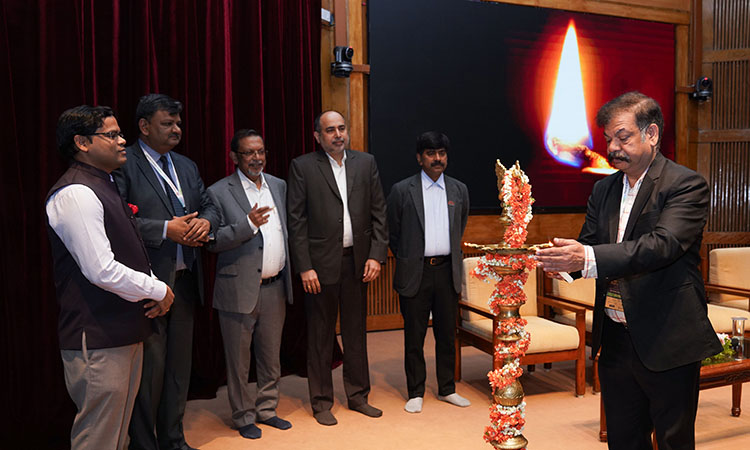
Day 1 of the conference began with the traditional lamp lighting ceremony by Dr. Aditya Gupta, Chief Operations Officer, SCMC, IIMB; Prof. Rajeev R. Tripathi, Chairperson, SCMC; Sujoy Guha, CEO & MD, CriticaLog; Ajay Nair, Partner and Leader for Supply Chain Transformation, PwC India; Prof. Dinesh Kumar, Director In-charge, IIM Bangalore; and Dr. Radha Mohan Gupta, Supply Chain Strategist, Independent Director and Mentor, Devyani International. The conference explored the rapidly evolving supply chain environment shaped by geopolitical disruptions, sustainability priorities, and the transformative rise of Generative AI.
At the heart of this year’s conference was the leadership of Dr. Aditya Gupta, Chief Operations Officer, Supply Chain Management Centre, and Head of the Supply Chain Sustainability Lab at IIM Bangalore. As the driving force behind the event, Dr. Gupta has, over the past four years, spearheaded the Institute’s initiatives on supply chain decarbonization, advancing research and publications, mentoring executives and students, guiding sustainability consulting for government and industry, and building partnerships that promote sustainable supply chain practices across sectors.
Inaugural Address
The conference opened with an address by Prof. Rajeev R. Tripathi, Chairperson of the Supply Chain Management Centre, IIMB. He framed the day’s discussions through an anecdote from his recent visit to Tirupur, where a garment manufacturer underscored the widening gap between Indian supply chain practices and those in more technologically advanced markets such as the UK and the US. Prof. Tripathi noted that many traditional manufacturing clusters continue to operate with limited use of AI-enabled forecasting and other digital tools, reflecting both a constraint and an opportunity for the domestic ecosystem.
He emphasized that the conference theme: Geopolitics, Sustainability, and GenAI, captures the urgency for modernization across Indian supply chains. His remarks highlighted the need for resilient operational planning and technology-led transformation, setting the strategic context for the sessions that followed.
Director’s Address
In his address, Prof. Dinesh Kumar, Director In-charge, IIM Bangalore, examined the rising volatility confronting global supply chains, illustrating how complexity has intensified in the past two decades. Through examples from oil and gas operations in Oman and L&T’s earth-moving equipment business, he demonstrated the role of AI in predictive maintenance, demand estimation, and performance management. Reinforcing the need for methodological rigour in adopting GenAI, he observed, Supply chains must be built for uncertainty, not stability.
Keynote Address 1
Ajay Nair, Partner and Leader for Supply Chain Transformation at PwC India, delivered the keynote address titled, Backroom to Boardroom: Securing Supply Chain’s Seat at the Table. He outlined six major forces that are redefining supply chains worldwide, including the increasing pace of disruptions, rapid technological advancements, talent shortages, rising ESG compliance expectations, the emergence of integrated business ecosystems, and intensifying pressure to support new business models.
Mr. Nair noted that the past three years have witnessed unprecedented levels of warehouse automation, with digital investments delivering payback periods of less than two years and driving improvements in both revenue and cost efficiency. As ESG commitments deepen across industries, sustainability must move from being a compliance obligation to a strategic priority embedded within core operations.
Drawing from PwC’s global research, he elaborated on four strategic themes that define ‘boardroom-ready’ supply chains. The first is the need for organisations to build strong digital foundations and enterprise-wide technological capability. The second is the imperative for innovation and responsiveness, particularly as GenAI adoption in supply chains is still nascent and requires robust data infrastructure. The third theme focuses on risk and resilience, where investments in cybersecurity, anti-corruption safeguards, and geopolitical risk monitoring are becoming essential. The final theme, sustainability and trust, emphasizes the growing board-level focus on Scope 3 emissions, green logistics, sustainable sourcing, and circular economy design.
He concluded by outlining five imperatives for the supply chain of the future: placing data at the centre of decision-making, accelerating digital transformation, strengthening ecosystem partnerships, designing operations aligned with ESG principles, and building the supply chain organisation of tomorrow.
Panel Discussion 1: The Future of Work in Supply Chains – Human + AI Collaboration
The first panel of the conference examined how work in supply chains is being redefined through human+AI collaboration. Moderated by Srihari Murthy, CEO and Founder of Factri.Ai, the discussion featured Pandurang Prabhu, VP, R&D, Manhattan Associates India, Sandeep Menon, Data Science Supply Chain, Juniper Networks, Boby Mohan, COO-South, TVS Supply Chain Solutions Ltd., and Ankit Kala, Chief of Network & Planning, Shadowfax.
Moderated by Srihari Murthy, the first panel examined how human capability and intelligent systems will jointly shape future supply chain work. Srihari Murthy framed the moment as both exciting and uncertain, reflecting the dual reactions to AI adoption.
Representing Manhattan Associates India, Pandurang Prabhu discussed the evolution from traditional algorithms to modern AI and agentic systems. He emphasised the challenges of integrating AI into legacy architectures and highlighted the need for transparency and accountability, remarking, the real question is not automation versus augmentation but how organisations prepare for both.
From Juniper Networks, Sandeep Menon described how his team synthesizes real-time geopolitical and supply velocity data to produce actionable risk alerts. His intervention emphasised the importance of practical AI deployment over high-level conceptual enthusiasm.
Boby Mohan, COO-South at TVS Supply Chain Solutions, focused on the operational value of AI-led orchestration. Drawing on the organisation’s digital platforms, he noted, Technology creates visibility and speed, but operational discipline converts those capabilities into outcomes.
Providing the hyperlocal view, Ankit Kala of Shadowfax illustrated how AI supports address validation, fraud detection, and network optimisation across a gig workforce managing more than two million daily deliveries.
Collectively, the panel highlighted that the effectiveness of AI will depend not only on technology but on human adaptability, workforce upskilling, and cross-functional collaboration.
Best Practices Session
The conference also featured a focused Best Practices Session under Track 2: Driving Sustainability Across the Supply Chain, moderated by Dr. Aditya Gupta, COO, Supply Chain Management Centre, IIMB.
Keynote Address 2
Prof. Sarang Deo, Operations Management, Indian School of Business, presented insights from two decades of field research across Sub-Saharan Africa and India, illustrating how operational decisions can materially shift health and welfare outcomes in resource-constrained settings.
He discussed the diagnostic supply chain for early infant HIV in Mozambique, where inefficiencies stemmed from dispatching patterns rather than transport delays. His modelling demonstrated how optimal clinic-to-lab assignments and novel diagnostic devices significantly improved turnaround times. He also shared findings from Malawi showing how minor adjustments to sample transport schedules strengthened diagnostic pathways.
Turning to India’s Public Distribution System, he examined how biometric authentication reduced diversion and enabled beneficiary choice, with his Telangana study showing a 6.6 percent increase in food-grain uptake. Reflecting on these insights, he observed, Simple operational interventions can create disproportionate impact when aligned with the realities of public systems.
Prof. Deo concluded by emphasising the transformative potential of supply chain tools in public health, the importance of interdisciplinary collaboration, the power of low-cost operational innovations, and the need to account for unintended but positive operational effects when designing policy interventions.
Breakout Sessions (Three Parallel Tracks)
The conference then moved into three parallel Breakout Tracks, each examining a core dimension of contemporary supply chain strategy. Track 1: Digital Transformation and the Role of AI in Supply Chains was led by Mohan Sitharam, Chief HR Officer at Shadowfax, and explored the organisational and technological shifts required to accelerate AI adoption. Track 2: Driving Sustainability Across the Supply Chain, moderated by Dr. Aditya Gupta, COO of the Supply Chain Management Centre, IIMB, focused on actionable pathways for decarbonization, responsible sourcing, and sustainability-led operational redesign. Track 3: Strengthening Supply Chain Resilience Amid Geopolitical Uncertainty, chaired by Dr. Radha Mohan Gupta, Supply Chain Strategist, Independent Director, Mentor, and former SVP at Devyani International, examined how firms can build robust, shock-responsive supply chains in an increasingly volatile global environment.
Click here for photo gallery
SCMC at IIMB hosted 9th Biennial Supply Chain Management Conference 2025
The Day 1 sessions focused on this year’s theme: Geopolitics, Sustainability, and GenAI
11 December 2025, Bangalore: The Supply Chain Management Centre (SCMC) at the Indian Institute of Management Bangalore inaugurated Day 1 of the 9th Biennial Supply Chain Management Conference 2025, convening a diverse audience of industry leaders, researchers, practitioners, and policymakers.
Day 1 of the conference began with the traditional lamp lighting ceremony by Dr. Aditya Gupta, Chief Operations Officer, SCMC, IIMB; Prof. Rajeev R. Tripathi, Chairperson, SCMC; Sujoy Guha, CEO & MD, CriticaLog; Ajay Nair, Partner and Leader for Supply Chain Transformation, PwC India; Prof. Dinesh Kumar, Director In-charge, IIM Bangalore; and Dr. Radha Mohan Gupta, Supply Chain Strategist, Independent Director and Mentor, Devyani International. The conference explored the rapidly evolving supply chain environment shaped by geopolitical disruptions, sustainability priorities, and the transformative rise of Generative AI.
At the heart of this year’s conference was the leadership of Dr. Aditya Gupta, Chief Operations Officer, Supply Chain Management Centre, and Head of the Supply Chain Sustainability Lab at IIM Bangalore. As the driving force behind the event, Dr. Gupta has, over the past four years, spearheaded the Institute’s initiatives on supply chain decarbonization, advancing research and publications, mentoring executives and students, guiding sustainability consulting for government and industry, and building partnerships that promote sustainable supply chain practices across sectors.
Inaugural Address
The conference opened with an address by Prof. Rajeev R. Tripathi, Chairperson of the Supply Chain Management Centre, IIMB. He framed the day’s discussions through an anecdote from his recent visit to Tirupur, where a garment manufacturer underscored the widening gap between Indian supply chain practices and those in more technologically advanced markets such as the UK and the US. Prof. Tripathi noted that many traditional manufacturing clusters continue to operate with limited use of AI-enabled forecasting and other digital tools, reflecting both a constraint and an opportunity for the domestic ecosystem.
He emphasized that the conference theme: Geopolitics, Sustainability, and GenAI, captures the urgency for modernization across Indian supply chains. His remarks highlighted the need for resilient operational planning and technology-led transformation, setting the strategic context for the sessions that followed.
Director’s Address
In his address, Prof. Dinesh Kumar, Director In-charge, IIM Bangalore, examined the rising volatility confronting global supply chains, illustrating how complexity has intensified in the past two decades. Through examples from oil and gas operations in Oman and L&T’s earth-moving equipment business, he demonstrated the role of AI in predictive maintenance, demand estimation, and performance management. Reinforcing the need for methodological rigour in adopting GenAI, he observed, Supply chains must be built for uncertainty, not stability.
Keynote Address 1
Ajay Nair, Partner and Leader for Supply Chain Transformation at PwC India, delivered the keynote address titled, Backroom to Boardroom: Securing Supply Chain’s Seat at the Table. He outlined six major forces that are redefining supply chains worldwide, including the increasing pace of disruptions, rapid technological advancements, talent shortages, rising ESG compliance expectations, the emergence of integrated business ecosystems, and intensifying pressure to support new business models.
Mr. Nair noted that the past three years have witnessed unprecedented levels of warehouse automation, with digital investments delivering payback periods of less than two years and driving improvements in both revenue and cost efficiency. As ESG commitments deepen across industries, sustainability must move from being a compliance obligation to a strategic priority embedded within core operations.
Drawing from PwC’s global research, he elaborated on four strategic themes that define ‘boardroom-ready’ supply chains. The first is the need for organisations to build strong digital foundations and enterprise-wide technological capability. The second is the imperative for innovation and responsiveness, particularly as GenAI adoption in supply chains is still nascent and requires robust data infrastructure. The third theme focuses on risk and resilience, where investments in cybersecurity, anti-corruption safeguards, and geopolitical risk monitoring are becoming essential. The final theme, sustainability and trust, emphasizes the growing board-level focus on Scope 3 emissions, green logistics, sustainable sourcing, and circular economy design.
He concluded by outlining five imperatives for the supply chain of the future: placing data at the centre of decision-making, accelerating digital transformation, strengthening ecosystem partnerships, designing operations aligned with ESG principles, and building the supply chain organisation of tomorrow.
Panel Discussion 1: The Future of Work in Supply Chains – Human + AI Collaboration
The first panel of the conference examined how work in supply chains is being redefined through human+AI collaboration. Moderated by Srihari Murthy, CEO and Founder of Factri.Ai, the discussion featured Pandurang Prabhu, VP, R&D, Manhattan Associates India, Sandeep Menon, Data Science Supply Chain, Juniper Networks, Boby Mohan, COO-South, TVS Supply Chain Solutions Ltd., and Ankit Kala, Chief of Network & Planning, Shadowfax.
Moderated by Srihari Murthy, the first panel examined how human capability and intelligent systems will jointly shape future supply chain work. Srihari Murthy framed the moment as both exciting and uncertain, reflecting the dual reactions to AI adoption.
Representing Manhattan Associates India, Pandurang Prabhu discussed the evolution from traditional algorithms to modern AI and agentic systems. He emphasised the challenges of integrating AI into legacy architectures and highlighted the need for transparency and accountability, remarking, the real question is not automation versus augmentation but how organisations prepare for both.
From Juniper Networks, Sandeep Menon described how his team synthesizes real-time geopolitical and supply velocity data to produce actionable risk alerts. His intervention emphasised the importance of practical AI deployment over high-level conceptual enthusiasm.
Boby Mohan, COO-South at TVS Supply Chain Solutions, focused on the operational value of AI-led orchestration. Drawing on the organisation’s digital platforms, he noted, Technology creates visibility and speed, but operational discipline converts those capabilities into outcomes.
Providing the hyperlocal view, Ankit Kala of Shadowfax illustrated how AI supports address validation, fraud detection, and network optimisation across a gig workforce managing more than two million daily deliveries.
Collectively, the panel highlighted that the effectiveness of AI will depend not only on technology but on human adaptability, workforce upskilling, and cross-functional collaboration.
Best Practices Session
The conference also featured a focused Best Practices Session under Track 2: Driving Sustainability Across the Supply Chain, moderated by Dr. Aditya Gupta, COO, Supply Chain Management Centre, IIMB.
Keynote Address 2
Prof. Sarang Deo, Operations Management, Indian School of Business, presented insights from two decades of field research across Sub-Saharan Africa and India, illustrating how operational decisions can materially shift health and welfare outcomes in resource-constrained settings.
He discussed the diagnostic supply chain for early infant HIV in Mozambique, where inefficiencies stemmed from dispatching patterns rather than transport delays. His modelling demonstrated how optimal clinic-to-lab assignments and novel diagnostic devices significantly improved turnaround times. He also shared findings from Malawi showing how minor adjustments to sample transport schedules strengthened diagnostic pathways.
Turning to India’s Public Distribution System, he examined how biometric authentication reduced diversion and enabled beneficiary choice, with his Telangana study showing a 6.6 percent increase in food-grain uptake. Reflecting on these insights, he observed, Simple operational interventions can create disproportionate impact when aligned with the realities of public systems.
Prof. Deo concluded by emphasising the transformative potential of supply chain tools in public health, the importance of interdisciplinary collaboration, the power of low-cost operational innovations, and the need to account for unintended but positive operational effects when designing policy interventions.
Breakout Sessions (Three Parallel Tracks)
The conference then moved into three parallel Breakout Tracks, each examining a core dimension of contemporary supply chain strategy. Track 1: Digital Transformation and the Role of AI in Supply Chains was led by Mohan Sitharam, Chief HR Officer at Shadowfax, and explored the organisational and technological shifts required to accelerate AI adoption. Track 2: Driving Sustainability Across the Supply Chain, moderated by Dr. Aditya Gupta, COO of the Supply Chain Management Centre, IIMB, focused on actionable pathways for decarbonization, responsible sourcing, and sustainability-led operational redesign. Track 3: Strengthening Supply Chain Resilience Amid Geopolitical Uncertainty, chaired by Dr. Radha Mohan Gupta, Supply Chain Strategist, Independent Director, Mentor, and former SVP at Devyani International, examined how firms can build robust, shock-responsive supply chains in an increasingly volatile global environment.
Click here for photo gallery