
SCMC at IIMB concludes Day 2 of 9th Biennial Supply Chain Management Conference
Keynotes and panels explored the future of logistics through the lenses of policy reform, decarbonization, and geopolitical disruption
12 December, 2025, Bangalore: The Supply Chain Management Centre (SCMC) at IIMB, concluded Day 2 of the 9th Biennial Supply Chain Management Conference 2025, marked by dynamic exchanges across academia, industry, and policymakers. Dr. Aditya Gupta, COO, SCMC and Head of the TCI Supply Chain Sustainability Lab, IIMB, highlighted, “The 9th Biennial Supply Chain Management Conference uniquely bridged academia and industry, fostering active engagement from both. Discussions focused on three transformative forces reshaping modern supply chains: Geopolitics, Sustainability, and Generative AI. A standout feature this year was the introduction of free-flowing group discussions, enabling participants to openly share experiences and insights across these themes, which was extremely well received.”
The Conference Co-chairs, Prof. Rajeev R Tripathi, Assistant Professor, Production and Operations Management, IIM Bangalore, and Prof. Nishant Kumar Verma, Associate Professor, Production and Operations Management, IIM Bangalore.
Reimagining Global and National Supply Chains in a Transforming World
Dr. Surendra Ahirwar, Executive Director, Traffic Commercial, Ministry of Railways, delivered the third keynote on Reimagining Global and National Supply Chains in a Transforming World. He talked about how India’s logistics ecosystem has transitioned from a fragmented, infrastructure-deficient environment to a more integrated, policy-driven, and digitally enabled system. He traced this evolution through three phases: the foundational period between 2017–2020, when logistics was formally recognised as a sector, and the Logistics Division was established; the COVID-19 phase, during which India accelerated digital reforms including digital bills of lading and the framework for the National Logistics Portal; and the post-2021 transformation shaped by the PM Gati Shakti National Master Plan.
Dr. Ahirwar underscored that PM Gati Shakti represents a globally unmatched initiative, integrating more than 1,600 geospatial layers to map surface and underground infrastructure, effectively laying the groundwork for a national digital twin. This capability, he noted, is already enhancing multimodal planning, network optimisation, and data-driven policymaking.
Calling resilience an essential, not optional, component of modern supply chain design, he pointed to recent industry disruptions where operationally efficient organisations suffered due to insufficient resilience investment. He closed by emphasising the growing strategic alignment across government, industry, academia, and media, which is accelerating India’s progress toward a smarter, more sustainable, and globally competitive logistics landscape.
Decarbonizing Global Value Chains – From Vision to Action
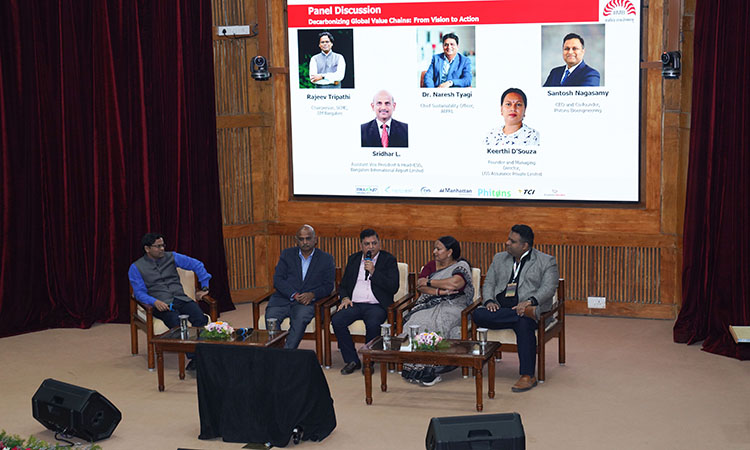
The second panel of the conference on Decarbonizing Global Value Chains – From Vision to Action, addressed the complexities of decarbonizing global value chains and the shift from high-level commitments to operational execution. Moderated by Prof. Rajeev R. Tripathi, Chairperson, Supply Chain Management Centre, IIM Bangalore, the session brought together Naresh Tyagi, Chief Sustainability Officer, Aditya Birla Fashion and Retail Ltd., ABFRL; Santosh Nagasamy, CEO & Co-Founder, Phitons Bioengineering; Sridhar L., AVP & Head – ESG, Bangalore International Airport Ltd.; and Keerthi D’Souza, Founder & MD, LGS Assurance and Co-chair, CAPS–CAHO.
Opening the discussion, Prof. Tripathi framed decarbonization as both a scientific challenge and an economic transition. Using a simple yet pointed analogy on atmospheric carbon concentration, he emphasized the dual pathways to climate action: advancing technology-driven solutions and reshaping conventional business practices. He noted that lasting progress requires addressing the root causes embedded in economic activity and organisational behaviour.
Representing the biomaterials and agritech ecosystem, Santosh Nagasamy highlighted the need for materials should be designed to work with nature and go back to nature. He explained why conventional plastics fail sustainability tests, not because they cannot be recycled but because they are not designed with an end-of-life that prevents landfill accumulation, incineration, or microplastic leakage. Sharing insights from Phitons Bioengineering, he described how compostable mulch films naturally degrade into soil nutrients, eliminating microplastics and reducing labour costs. His key message underscored the crossroads India now faces, “Behavioural change is paramount; strict norms are essential to accelerate sustainable adoption.”
Offering a perspective from healthcare and standards ecosystems, Keerthi D’Souza discussed the reality that decarbonization varies significantly across sectors due to differences in value-chain complexity. Using a hospital construction case study, she demonstrated how sustainability must be embedded from the blueprint stage through the entire lifecycle. She emphasized that organisations need a clear understanding of where their risks reside across the value chain, stating that each industry must first understand its value chain before it can influence it.
Turning to the fashion and apparel industry, Naresh Tyagi addressed the environmental and social pressures shaping one of the world’s largest and most fragmented value chains. Tracing the rise of fast and ultra-fast fashion, from two seasons a year to twelve, he illustrated the footprint implications across production, consumption, and disposal. With ABFRL now ranked #1 in Indian retail and #4 globally in the S&P Global Corporate Sustainability Assessment (2025), he highlighted the role of brand owners and consumers in driving responsible growth. His core insight was clear, “Responsibility is shared; both consumers and brand owners must demand and deliver sustainability.”
Bringing an operations-intensive view from aviation, Sridhar L. of Bangalore International Airport Ltd. outlined BIAL’s decarbonization pathway anchored in the principles of being a catalyst, consistent, collaborative, and committed. Having achieved Scope 1 and 2 neutrality seven years ahead of its 2030 target and being the first airport in Asia to receive Level 5 Carbon Accreditation from Airports Council International, he stressed the importance of long-term thinking. His reflection summed up BIAL’s approach: We are paid to think for the future, to think big.
Navigating Geopolitical Shocks and Global Risks
The final panel of Day 2, moderated by Tariq Ahmed, Editor, Logistics Insider, examined supply chain vulnerabilities against the backdrop of escalating geopolitical tensions, macroeconomic uncertainty, and increasingly frequent global risk cycles. Tariq opened the discussion by inviting speakers to reflect on geopolitical moments that had directly shaped their supply chain decisions, framing a wide-ranging, data-driven conversation on organisational preparedness, resilience, and strategic agility.
Setting the context, the panel acknowledged that 2024–25 has been one of the most volatile periods in global logistics in two decades, with nearly 70 percent of manufacturing firms reporting disruption. With global logistics travel distances rising by 10 percent and the Red Sea crisis reducing Suez Canal trade by almost 50 percent, Indian firms have faced acute pressures around capacity, congestion, cost escalation, and on-time delivery, all prompting a fundamental re-evaluation of risk management frameworks.
Representing the operations perspective, N. Ramakrishnan, Director – Service Operations & Domestic Logistics, Flextronics, underscored that uncertainty has now become a standing item in monthly board meetings. He emphasised the need for cross-functional collaboration between operations, finance, supply chain, and legal teams, supported by rapid, data-led decision cycles and RASCI-based ownership structures. His central message, “Resilience cannot be an annual exercise; it must be reviewed monthly, weekly, and sometimes even daily.”
From the manufacturing and procurement viewpoint, Jayakumar Mano, Retired Vice President, Mobility Purchasing, Bosch Limited, observed that supply chains remain the weakest link in the global value system. He highlighted the growing Reverse China strategy, as companies diversify supply bases to mitigate concentration risk, a pressing concern given that 90 percent of India’s containers are still imported from China. Warning that the “weaponisation of trade may be more disruptive than war itself,” he stressed the need for organisations to develop rapid-response capabilities. His key insight was succinct: Either prepare well for the foreseeable future or build the capability to react faster to the situation.
Adding a nutraceutical industry lens, Dinesh P. S, Senior Director – Supply Chain Management, Herbalife Nutrition, detailed the sector’s heavy reliance on imported raw materials with strict shelf-life constraints. Geopolitical conflicts, natural calamities, and abrupt regulatory shifts extend import lead times and create conversion bottlenecks. While his organisation has reduced import dependence from 80–90 percent to nearly 50 percent through local vendor development, he noted that deeper localisation is imperative for consistent supply. As he put it, “Localisation is not just a cost strategy, it is a resilience strategy.”
Representing the logistics service provider ecosystem, Hitesh Sen, Regional Head, TCI Supply Chain Solutions, noted that geopolitical shocks impact logistics networks first and most visibly. With customers demanding real-time visibility and high fulfilment reliability, providers are shifting from Just-in-Time to Just-in-Case, positioning inventory closer to demand centres. This transition is fuelling investments in digital control towers, route optimisation tools, and AI-enabled monitoring. His core view is, “Volatility is here to stay, visibility and preparedness are the only real advantages.”
Prof. Mukta Kulkarni, Dean, Programmes, Chairperson, Office of International Affairs, IIMB, addressed the gathering at the valedictory session and spoke about AI-enabled operations, supply chain risk and resilience, and the growing geopolitical complexities impacting trade and logistics.
Click here for photo gallery
Click here for Day 1 release
SCMC at IIMB concludes Day 2 of 9th Biennial Supply Chain Management Conference
Keynotes and panels explored the future of logistics through the lenses of policy reform, decarbonization, and geopolitical disruption
12 December, 2025, Bangalore: The Supply Chain Management Centre (SCMC) at IIMB, concluded Day 2 of the 9th Biennial Supply Chain Management Conference 2025, marked by dynamic exchanges across academia, industry, and policymakers. Dr. Aditya Gupta, COO, SCMC and Head of the TCI Supply Chain Sustainability Lab, IIMB, highlighted, “The 9th Biennial Supply Chain Management Conference uniquely bridged academia and industry, fostering active engagement from both. Discussions focused on three transformative forces reshaping modern supply chains: Geopolitics, Sustainability, and Generative AI. A standout feature this year was the introduction of free-flowing group discussions, enabling participants to openly share experiences and insights across these themes, which was extremely well received.”
The Conference Co-chairs, Prof. Rajeev R Tripathi, Assistant Professor, Production and Operations Management, IIM Bangalore, and Prof. Nishant Kumar Verma, Associate Professor, Production and Operations Management, IIM Bangalore.
Reimagining Global and National Supply Chains in a Transforming World
Dr. Surendra Ahirwar, Executive Director, Traffic Commercial, Ministry of Railways, delivered the third keynote on Reimagining Global and National Supply Chains in a Transforming World. He talked about how India’s logistics ecosystem has transitioned from a fragmented, infrastructure-deficient environment to a more integrated, policy-driven, and digitally enabled system. He traced this evolution through three phases: the foundational period between 2017–2020, when logistics was formally recognised as a sector, and the Logistics Division was established; the COVID-19 phase, during which India accelerated digital reforms including digital bills of lading and the framework for the National Logistics Portal; and the post-2021 transformation shaped by the PM Gati Shakti National Master Plan.
Dr. Ahirwar underscored that PM Gati Shakti represents a globally unmatched initiative, integrating more than 1,600 geospatial layers to map surface and underground infrastructure, effectively laying the groundwork for a national digital twin. This capability, he noted, is already enhancing multimodal planning, network optimisation, and data-driven policymaking.
Calling resilience an essential, not optional, component of modern supply chain design, he pointed to recent industry disruptions where operationally efficient organisations suffered due to insufficient resilience investment. He closed by emphasising the growing strategic alignment across government, industry, academia, and media, which is accelerating India’s progress toward a smarter, more sustainable, and globally competitive logistics landscape.
Decarbonizing Global Value Chains – From Vision to Action
The second panel of the conference on Decarbonizing Global Value Chains – From Vision to Action, addressed the complexities of decarbonizing global value chains and the shift from high-level commitments to operational execution. Moderated by Prof. Rajeev R. Tripathi, Chairperson, Supply Chain Management Centre, IIM Bangalore, the session brought together Naresh Tyagi, Chief Sustainability Officer, Aditya Birla Fashion and Retail Ltd., ABFRL; Santosh Nagasamy, CEO & Co-Founder, Phitons Bioengineering; Sridhar L., AVP & Head – ESG, Bangalore International Airport Ltd.; and Keerthi D’Souza, Founder & MD, LGS Assurance and Co-chair, CAPS–CAHO.
Opening the discussion, Prof. Tripathi framed decarbonization as both a scientific challenge and an economic transition. Using a simple yet pointed analogy on atmospheric carbon concentration, he emphasized the dual pathways to climate action: advancing technology-driven solutions and reshaping conventional business practices. He noted that lasting progress requires addressing the root causes embedded in economic activity and organisational behaviour.
Representing the biomaterials and agritech ecosystem, Santosh Nagasamy highlighted the need for materials should be designed to work with nature and go back to nature. He explained why conventional plastics fail sustainability tests, not because they cannot be recycled but because they are not designed with an end-of-life that prevents landfill accumulation, incineration, or microplastic leakage. Sharing insights from Phitons Bioengineering, he described how compostable mulch films naturally degrade into soil nutrients, eliminating microplastics and reducing labour costs. His key message underscored the crossroads India now faces, “Behavioural change is paramount; strict norms are essential to accelerate sustainable adoption.”
Offering a perspective from healthcare and standards ecosystems, Keerthi D’Souza discussed the reality that decarbonization varies significantly across sectors due to differences in value-chain complexity. Using a hospital construction case study, she demonstrated how sustainability must be embedded from the blueprint stage through the entire lifecycle. She emphasized that organisations need a clear understanding of where their risks reside across the value chain, stating that each industry must first understand its value chain before it can influence it.
Turning to the fashion and apparel industry, Naresh Tyagi addressed the environmental and social pressures shaping one of the world’s largest and most fragmented value chains. Tracing the rise of fast and ultra-fast fashion, from two seasons a year to twelve, he illustrated the footprint implications across production, consumption, and disposal. With ABFRL now ranked #1 in Indian retail and #4 globally in the S&P Global Corporate Sustainability Assessment (2025), he highlighted the role of brand owners and consumers in driving responsible growth. His core insight was clear, “Responsibility is shared; both consumers and brand owners must demand and deliver sustainability.”
Bringing an operations-intensive view from aviation, Sridhar L. of Bangalore International Airport Ltd. outlined BIAL’s decarbonization pathway anchored in the principles of being a catalyst, consistent, collaborative, and committed. Having achieved Scope 1 and 2 neutrality seven years ahead of its 2030 target and being the first airport in Asia to receive Level 5 Carbon Accreditation from Airports Council International, he stressed the importance of long-term thinking. His reflection summed up BIAL’s approach: We are paid to think for the future, to think big.
Navigating Geopolitical Shocks and Global Risks
The final panel of Day 2, moderated by Tariq Ahmed, Editor, Logistics Insider, examined supply chain vulnerabilities against the backdrop of escalating geopolitical tensions, macroeconomic uncertainty, and increasingly frequent global risk cycles. Tariq opened the discussion by inviting speakers to reflect on geopolitical moments that had directly shaped their supply chain decisions, framing a wide-ranging, data-driven conversation on organisational preparedness, resilience, and strategic agility.
Setting the context, the panel acknowledged that 2024–25 has been one of the most volatile periods in global logistics in two decades, with nearly 70 percent of manufacturing firms reporting disruption. With global logistics travel distances rising by 10 percent and the Red Sea crisis reducing Suez Canal trade by almost 50 percent, Indian firms have faced acute pressures around capacity, congestion, cost escalation, and on-time delivery, all prompting a fundamental re-evaluation of risk management frameworks.
Representing the operations perspective, N. Ramakrishnan, Director – Service Operations & Domestic Logistics, Flextronics, underscored that uncertainty has now become a standing item in monthly board meetings. He emphasised the need for cross-functional collaboration between operations, finance, supply chain, and legal teams, supported by rapid, data-led decision cycles and RASCI-based ownership structures. His central message, “Resilience cannot be an annual exercise; it must be reviewed monthly, weekly, and sometimes even daily.”
From the manufacturing and procurement viewpoint, Jayakumar Mano, Retired Vice President, Mobility Purchasing, Bosch Limited, observed that supply chains remain the weakest link in the global value system. He highlighted the growing Reverse China strategy, as companies diversify supply bases to mitigate concentration risk, a pressing concern given that 90 percent of India’s containers are still imported from China. Warning that the “weaponisation of trade may be more disruptive than war itself,” he stressed the need for organisations to develop rapid-response capabilities. His key insight was succinct: Either prepare well for the foreseeable future or build the capability to react faster to the situation.
Adding a nutraceutical industry lens, Dinesh P. S, Senior Director – Supply Chain Management, Herbalife Nutrition, detailed the sector’s heavy reliance on imported raw materials with strict shelf-life constraints. Geopolitical conflicts, natural calamities, and abrupt regulatory shifts extend import lead times and create conversion bottlenecks. While his organisation has reduced import dependence from 80–90 percent to nearly 50 percent through local vendor development, he noted that deeper localisation is imperative for consistent supply. As he put it, “Localisation is not just a cost strategy, it is a resilience strategy.”
Representing the logistics service provider ecosystem, Hitesh Sen, Regional Head, TCI Supply Chain Solutions, noted that geopolitical shocks impact logistics networks first and most visibly. With customers demanding real-time visibility and high fulfilment reliability, providers are shifting from Just-in-Time to Just-in-Case, positioning inventory closer to demand centres. This transition is fuelling investments in digital control towers, route optimisation tools, and AI-enabled monitoring. His core view is, “Volatility is here to stay, visibility and preparedness are the only real advantages.”
Prof. Mukta Kulkarni, Dean, Programmes, Chairperson, Office of International Affairs, IIMB, addressed the gathering at the valedictory session and spoke about AI-enabled operations, supply chain risk and resilience, and the growing geopolitical complexities impacting trade and logistics.
Click here for photo gallery
Click here for Day 1 release