
Research and Publication at IIMB concludes Winter Research Methodology Workshop 2025 on 06 December
75 Scholars receive certificates at the Valediction
06 December, 2025, Bangalore: The Research & Publications Office at the Indian Institute of Management Bangalore (IIMB) successfully concluded the Winter Research Methodology Workshop 2025, held from 1 to 6 December. The week-long initiative equipped emerging researchers and doctoral scholars with essential skills in expert qualitative, quantitative, and mixed methods research.
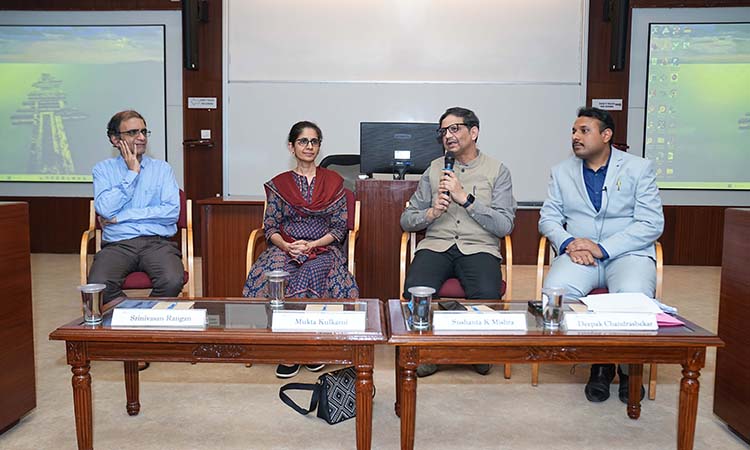
The final day featured the Editors’ Roundtable moderated by Programme Director Prof. Deepak Chandrashekar, Strategy area, IIMB. The Editors’ Roundtable brought together IIMB faculty members who serve in leading editorial roles across top-tier international journals. He emphasized the importance of clarity and transparency when submitting multiple manuscripts to journals. “Be explicit about what makes this paper different, its unique contribution, the specific question it answers, and why it deserves independent consideration. Clarity here isn’t optional; it’s essential,” he said.
Opening the discussion, Programme Director, Prof. Sushanta Kumar Mishra, Chairperson of Research & Publications, Centre for Teaching & Learning, and C-DOCTA, Editor-in-Chief of IIMB Management Review (IMR), and faculty of OBHRM, reflected on the sharply rising volume of global submissions and the importance of clarity in contribution, conceptual rigour, and journal fit. He noted that the introduction and abstract often determine whether a manuscript survives initial screening. “A strong paper begins with a strong conceptual anchor,” he said.
Prof. Mukta Kulkarni, Dean Programmes, OBHRM area, IIMB, highlighted the value of situating one’s research within ongoing scholarly conversations, urging early-career researchers to stay closely attuned to recently published work in their fields. She noted that most desk rejections stem from a lack of theoretical alignment or unclear contribution.
“Editors look for work that meaningfully extends what we already know. When scholars show that they understand the conversation they are entering, the paper immediately stands on firmer ground,” she remarked.
Prof. Srinivasan Rangan, Chairperson, Finance & Accounting area, drew attention to the indispensable role of methodological precision and theoretical clarity in securing publication in top-tier journals. He also addressed common concerns around reviewer feedback, explaining that transparent, reasoned responses and respectful engagement greatly strengthen a revised submission.
“Revision is not about pleasing every reviewer; it is about demonstrating that you have thought deeply, acted rigorously, and responded professionally,” he noted.
Valedictory Session
A valedictory session on Doing meaningful Research by Prof. Pulak Ghosh, Decision Sciences area at IIMB, and Member, India’s Economic Advisory Council, shared invaluable insights on research, academics, and policy impact. Emphasizing the evolving nature of knowledge and the rapid pace of change in every field, he highlighted the necessity of research to stay relevant:
“Your sources of knowledge have multiplied. The era of the ‘cult teacher’ is gone, and to stand out in the classroom, you must bring something new.”
He urged PhD students to be self-critical, patient, and committed, stressing that connecting research to real-world policy experiments, especially in a dynamic country like India, offers a unique opportunity to influence both academia and national progress.
The Editors’ Roundtable set the stage for the Valediction Ceremony, where faculty coordinators commended the commitment, curiosity, and scholarly enthusiasm of the 75 participants, who received certificates marking the successful completion of the Winter Research Methodology Workshop 2025.
Click here for photo gallery
Click here for Day 1 release
Research and Publication at IIMB concludes Winter Research Methodology Workshop 2025 on 06 December
75 Scholars receive certificates at the Valediction
06 December, 2025, Bangalore: The Research & Publications Office at the Indian Institute of Management Bangalore (IIMB) successfully concluded the Winter Research Methodology Workshop 2025, held from 1 to 6 December. The week-long initiative equipped emerging researchers and doctoral scholars with essential skills in expert qualitative, quantitative, and mixed methods research.
The final day featured the Editors’ Roundtable moderated by Programme Director Prof. Deepak Chandrashekar, Strategy area, IIMB. The Editors’ Roundtable brought together IIMB faculty members who serve in leading editorial roles across top-tier international journals. He emphasized the importance of clarity and transparency when submitting multiple manuscripts to journals. “Be explicit about what makes this paper different, its unique contribution, the specific question it answers, and why it deserves independent consideration. Clarity here isn’t optional; it’s essential,” he said.
Opening the discussion, Programme Director, Prof. Sushanta Kumar Mishra, Chairperson of Research & Publications, Centre for Teaching & Learning, and C-DOCTA, Editor-in-Chief of IIMB Management Review (IMR), and faculty of OBHRM, reflected on the sharply rising volume of global submissions and the importance of clarity in contribution, conceptual rigour, and journal fit. He noted that the introduction and abstract often determine whether a manuscript survives initial screening. “A strong paper begins with a strong conceptual anchor,” he said.
Prof. Mukta Kulkarni, Dean Programmes, OBHRM area, IIMB, highlighted the value of situating one’s research within ongoing scholarly conversations, urging early-career researchers to stay closely attuned to recently published work in their fields. She noted that most desk rejections stem from a lack of theoretical alignment or unclear contribution.
“Editors look for work that meaningfully extends what we already know. When scholars show that they understand the conversation they are entering, the paper immediately stands on firmer ground,” she remarked.
Prof. Srinivasan Rangan, Chairperson, Finance & Accounting area, drew attention to the indispensable role of methodological precision and theoretical clarity in securing publication in top-tier journals. He also addressed common concerns around reviewer feedback, explaining that transparent, reasoned responses and respectful engagement greatly strengthen a revised submission.
“Revision is not about pleasing every reviewer; it is about demonstrating that you have thought deeply, acted rigorously, and responded professionally,” he noted.
Valedictory Session
A valedictory session on Doing meaningful Research by Prof. Pulak Ghosh, Decision Sciences area at IIMB, and Member, India’s Economic Advisory Council, shared invaluable insights on research, academics, and policy impact. Emphasizing the evolving nature of knowledge and the rapid pace of change in every field, he highlighted the necessity of research to stay relevant:
“Your sources of knowledge have multiplied. The era of the ‘cult teacher’ is gone, and to stand out in the classroom, you must bring something new.”
He urged PhD students to be self-critical, patient, and committed, stressing that connecting research to real-world policy experiments, especially in a dynamic country like India, offers a unique opportunity to influence both academia and national progress.
The Editors’ Roundtable set the stage for the Valediction Ceremony, where faculty coordinators commended the commitment, curiosity, and scholarly enthusiasm of the 75 participants, who received certificates marking the successful completion of the Winter Research Methodology Workshop 2025.
Click here for photo gallery
Click here for Day 1 release