
IMR Doctoral Conference 2026 kicks off with special talk on ‘Hyper-Digital Marketing: Six Pillars of Strategic Brand Marketing in an AI-powered World’
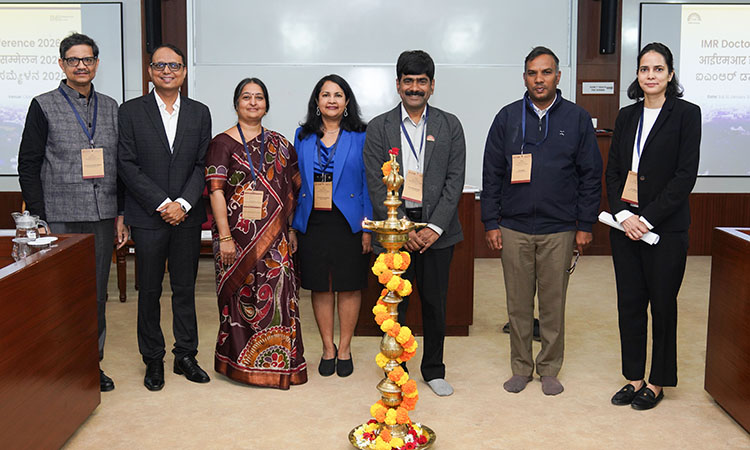
Prof. Vanitha Swaminathan, University of Pittsburgh, delivers keynote address offering a roadmap to business leaders on navigating changes due to rapidly changing technology, on Day One of the 17th IMRDC, being held on 9th and 10th January 2026
9 January, 2026, Bengaluru: “Our job as professionals is to understand consumers and what drives their preferences – what allows consumers to choose one product over another – in the face of rapid changes in technology and the rise of AI, which have heralded a new era”, observed Prof. Vanitha Swaminathan, Thomas Marshall Professor of Marketing and Director, Center for Branding at the University of Pittsburgh School of Business, while delivering the keynote address on, ‘Hyper-Digital Marketing: Six Pillars of Strategic Brand Marketing in an AI-powered World’, earlier today at IIM Bangalore. She was speaking on Day One of the IMR Doctoral Conference 2026 (IMRDC 2026), organized by Indian Institute of Management Bangalore’s flagship quarterly journal IIMB Management Review (IMR) and the Office of the Doctoral Programme, being held on 9th and 10th January 2026. Faculty, doctoral students, researchers and practitioners from affiliated fields have participated in the conference.
The 17th IMRDC consists of a limited hybrid model to facilitate the participation of virtual delegates. This year, the two-day event comprises the keynote address, panel discussions, select paper presentations by doctoral students, networking, and more.
The IMR Doctoral Conference 2026 Co-chairs are IIMB faculty Prof. Malika of the Marketing area and Prof. Varun Jindal of the Finance & Accounting area. The conference Co-hosts are IIM Bangalore faculty Prof. Sushanta K Mishra, Editor-in-Chief, IIMB Management Review, Chairperson, Research & Publications, C-DOCTA and Centre for Teaching & Learning, and faculty of the Organizational Behavior & Human Resources Management area, and Prof. Kanchan Mukherjee, Chairperson, Doctor of Philosophy (PhD) and faculty in the Organizational Behavior & Human Resources Management area.
For further information, please visit: https://www.iimb.ac.in/imrdc2026/
Keynote address
Prof. Vanitha Swaminathan termed the new era as the era of hyper-digitalization. From pre-digital to digital, to hyper-digital, she explained the evolution process and how hyper-digitalization, propelled by AI, is impacting the world of marketing. “This kind of shift has significant impact on how organizations and enterprises carry out critical functions across various areas, including marketing, information technology, human resources, etc. Many traditional roles are being replaced by new roles that depend heavily on cross-functional coordination. These changes could be far-reaching and have already dramatically impacted several tasks within organizations.” Her talk offered modern marketers and technologists a guide on navigating many such changes occurring in organizations, as well as managing consumer attention deficit syndrome. "Attention is a critical metric, which has seen a decline with people always being connected to different devices. This in turn has resulted in decreasing attention to advertisements over time", she pointed out. "Higher engagement can be brought about through attention, resonance and brand trust, and shifts in brand communications."
“In the pre-digital era we have seen standardized product offerings, while digital era saw customization of such offerings, and in the hyper-digital era there would be highly customized offerings which are tailored to each customer, using AI to help with personalization and scale.”
Drawing from the book authored by her with the same title, she discussed a new framework with six pillars of modern marketing strategy in the age of hyper-digitalization – purpose, phygital (combination of physical and digital) experiences, platform, participation, personalization and partnerships – which is aimed to help manage branding in this AI-powered age.
She explained the associated opportunities and challenges of each pillar. “Brand purpose will help build a consistent platform, strengthen brand image and boost employee morale. Leadership has to devise a public relations strategy way ahead of time to deal with negative publicity.” Discussing phygital, she said companies have to design strategy so that transformation from physical to digital is seamless. She listed the types of platforms as commerce, content, community and collaboration. “They will have stronger growth and adaptability than non-platforms, and connect multiple users as a group, which will result in higher efficiency and profitability. Platforms are here to stay”, she announced. “Participation will comprise value creation, customer insights and loyalty, improved customer experience and higher willingness to pay. Personalization will cover product, promotion, communication, and more.” Discussing partnerships she said, “In future, the partnership ecosystem with various forms of content creators and influencers will continue to grow.”
Addressing queries from the audience during the Q&A session following her talk, she pointed out that hyper customization may put customers off for being over-intrusive; academicians and researchers need to keep reinventing themselves to stay relevant; and that guardrails and governance systems need to be put in place to have responsible AI. She hailed the IMR Doctoral Conference for creating the opportunity for young researchers to gain knowledge, network with peers and experts and find opportunities, get feedback on work, and boost professional skills. “These types of conferences foster valuable connections and collaborations. Make best use of this time to learn about each other’s work”, Prof. Vanitha Swaminathan advised the budding researchers.
Prof. Malika had introduced the keynote speaker, who was felicitated after her talk by Prof. M Jayadev, Dean, Administration; Chairperson, Centre for Capital Markets & Risk Management, and faculty of the Finance & Accounting area of IIMB.
Welcome addresses
Earlier in the day, while delivering the welcome address, Prof. U Dinesh Kumar, Director In-charge, IIMB, provided valuable inputs on writing papers to budding researchers present at the conference. “Draft your paper very well and ensure it does not get rejected, select journals for publication wisely, and focus on the impact of your paper on society”, he advised.
Prof. Sushanta K Mishra spoke about IMR and IMRDC. “Papers published in IMR reach many scholars in India. IMRDC facilitates high quality research by helping build valuable collaborations.” To the participants, he highlighted the importance of impact of research, beyond publications.
Prof. Kanchan Mukherjee stated that feedback received during paper presentations at the conference will help advance the papers towards publication.
Panel Discussion 1: Navigating the Academic Job Market: Directors’ Insights
The panelists comprised Directors of premier business schools in India, including Prof. Ashok Banerjee, Director, IIM Udaipur; Prof. Ajit Parulekar, Director, Goa Institute of Management; Prof. Vinita Sahay, Director, IIM Bodh Gaya and also Founding Chairperson of the Fellow Programme in Management at IIM Raipur; and Prof. Naliniprava Tripathy, Director In-charge, IIM Shillong. The panel was moderated by Prof. Rishikesha T Krishnan, Professor In-charge, New Campus and faculty of the Strategy area, IIM Bangalore. Prof. Varun Jindal introduced the panelists.
The session focussed on how management education will evolve in the years ahead, the role of faculty in the changing scenario in the face of a very dynamic technology landscape, and what the deciding factors would be for institutes while hiring new faculty.
Prof. Ashok Banerjee opined that while India does not have a supply problem yet in terms of management education, but quality is surely an area needing improvement. “While specialized programmes will gain more popularity in the future, the fact remains that we also need managers and business leaders if the country has to attain its vision to be a developed nation by 2047. Recruiters also look at candidates with more hands-on experience.” Sharing IIM Udaipur’s selection criteria while hiring new faculty, he said, “What we look for is their CV and research focus, theoretical knowledge, and ability to fit into the organizational or programme culture.” Prof. Banerjee advised the aspirants that part of their grooming should include involving with a company in their line of research, to better understand business.
Lamenting the declining need for management education and faculty, Prof. Ajit Parulekar said, “The go-to person now is the computer and not the professor, some may argue. Industries are also pushing educational institutes to be more of training institutes than academic ones. However, since Indian students are risk averse, the tried and tested pattern will continue for some more time. Moreover, although apparently faculty engagement has declined, faculty continue to still play a crucial role for many students, who also look at an institute’s faculty line-up before seeking admission.” He added that GIM’s top few faculty hiring criteria include focus on coursework, research and meaningful publications, correlation between publication and scholarship, industry experience, and administrative capabilities. He stated that from the recruiters’ standpoint, specialized programmes are doing well currently. Prof. Parulekar said that the rise of interest in skip-college and other such newer models may be a cause for concern, and also pointed out that students should find faculty research relevant.
Terming the role of faculty as being close to her heart, Prof. Vinita Sahay said that the future depends a lot in devising the right kind of teaching methods. “Teachers have a big role to play, and in great demand, not just in the area of academics, but also in industry, the government, the non-profits, and more.” She said that while hiring, IIM Bodh Gaya does not just focus on PhD degrees, but also on practice background, conceptual clarity, research pipeline, relevant and updated knowledge, etc. “Being in academics means you need to be lifelong learners, so keep updating yourself”, advised Prof. Sahay.
“There are huge opportunities in India for the academic job market, especially for those who deal with clarity and purpose, and strive to create impact”, observed Prof. Naliniprava Tripathy. Stating that research is the backbone of academic excellence, she added, “India-centric research, and what you can do with what you know, would be more important. India needs more research scholars with new skillsets.” Discussing IIM Shillong’s hiring process, she said, “We look into aspects such as teaching, research and institutional fit. How a faculty member can engage with as well as handle students and align with the mission of the institute, their sense of judgment and ethics, are areas that may prove crucial. Moreover, they have to be able to adapt to changes in the future in terms of pedagogy, technology, and more.” Prof. Tripathy’s advice to the aspirants was, “Before appearing for an interview to be recruited as faculty, do look into the institute’s expectations. India is a model right now, your qualifications will open a lot of doors. With resilience and presence, you can sustain and become successful academicians.”
Prof. R T Krishnan listed some of IIMB’s priority areas while looking to hire new faculty as research, teaching and alignment with expectations of the Institute, for which he advised aspirants to make a case for themselves in terms of their tenure goals. Suggesting ways to address challenges in the face of rapidly evolving technology, he said, “The teaching methods of yore may not stay relevant, hence you have to keep upgrading your technical skills and be creative in order to be more effective in the classroom. Going forward, creativity and newer approaches will have more premium.” Addressing a query during the Q&A session following the discussion, Prof. R T Krishnan said that consistency in prior academic performance is a deciding factor for selection of PhD students.
Panel Discussion 2: Cracking the Code: How to Publish in Top-tier Journals
The young faculty panel representing premier institutions included Dr. Girija Borker, Research Economist, World Bank; Prof. Aditya Kuvalekar, University of Essex; Prof. Samarpan Nawn, IIM Udaipur; Prof. Vedha Ponnappan, IIM Udaipur, and Prof. Vipin Sreekumar, Masters’ Union School of Business. The panel moderator was Prof. Mukta Kulkarni, Dean, Programmes; Chairperson, Office of International Affairs, and faculty of the Organizational Behavior & Human Resources Management area of IIMB. Prof. Malika introduced the panelists.
The panel members discussed their first publication in a top-tier journal, the issue of quality versus quantity, working with mentors and technology, how to select publications, the review process, dealing with rejections, and more.
Dr. Girija Borker said that her first big publication was in The Quarterly Journal of Economics. “To be able to publish in top journals, you need a lot of patience. In case of gaping holes in your research, rework on your paper. Remember, it is a learning process. Try to produce best possible papers, focus on improvement based on feedback from reviewers, and learn from comments during presentations. Make the abstract as interesting as possible and handle reviewer feedback with respect and gratitude. Write on topics that may help your other research. Networking is valuable too. Moreover, PhD students need to make the best out of newer methods available, take more ownership and be more proactive going forward. Also, try to stay detached to a certain extent.” During the Q&A session following the panel discussion, Dr. Borker recommended making few, but genuine connections to best utilize the value of networking, in the field of research and publications.
Prof. Aditya Kuvalekar’s first top-tier publication was in American Economic Review, and he shared that although his paper was rejected a few times, what worked for him was rewriting the paper each time it was rejected. The paper was submitted multiple times also. “That really makes a difference. Soliciting feedback improves the quality of a paper. I would suggest that you be thorough – the authors’ contribution should be substantial and referee report has to be accepted with gratitude. Building a sound framework is necessary too. Quantity matters as well, as more and more people get to know you and your work due to the numbers.” Discussing taking help of technology while writing papers, Prof. Kuvalekar said that for him, ChatGPT has acted as an aide. He also suggested being hands-on while working with mentors.
Addressing the audience, Prof. Samarpan Nawn said that since empirical work takes a very long time sometimes, researchers need to have belief, and not desperation. “Make a good quality draft, and present your paper at multiple conferences to get additional reviewer feedback. More generic research is more likely to find place in top-tier journals. Do not fear submitting to top journals, and keep trying. Focus on writing the first three paragraphs very well, as that could be the deciding factor for editors to reject a paper, or not. Make your paper unique. When dealing with top journals, remember you will be treated fairly. Send to publications of different categories to increase numbers…also, more reviewers will be aware of your work if you present at different conferences. Sit on rejections, and then address reviewer comments effectively. India-specific research has become very relevant. Remember, the product has to be good – just networking may not help”, pointed out Prof. Nawn.
Prof. Vedha Ponnappan, whose first top-tier publication was in Journal of Marketing, informed the audience that working with a partner organization aided her research. “A very useful review team gave constructive suggestions. Top-tier journals want us to go in depth into the research question to find proof that it is working. We addressed review comments effectively.” Charting a strategy for emerging researchers, she added, “You need to map the contribution of your paper to journal publications. Best journals are the best place to start as feedback from top journals is a class apart, even if the paper gets rejected. Ensure that the writing is good enough to not get desk rejected, and assess if the paper is at the right stage to be submitted. Put sincere efforts in addressing and applying reviewer comment. Response to reviewer document is also important.” Explaining the value of networking, she said, “You get to know more about emerging topics through others’ work that way. It also helps you to collaborate with senior researchers who can guide you further in positioning papers. We need to market our research to be accepted”, Prof. Ponnappan explained.
With his first big publication in the Academy of Management Annals, Prof. Vipin Sreekumar recommended having an audience in mind while choosing a journal to submit research work. “Moreover, have the target audience in mind while writing the introduction. You want to reach the best audience through publication in top journals. However, understanding the fit of the paper with the journal is crucial. Read and acknowledge every reviewer comment, and do more than what is suggested by them. Make your response document easy to understand”, Prof. Sreekumar advised.
Prof. Mukta Kulkarni, while summing up, highlighted the importance of novelty of topic, quality of writing especially the introduction and abstract, a comprehensive response document, etc., for success in publication. “Look at the bigger picture and change what is required, then look into the micro details.”
The first day of IMRDC 2026 also saw paper presentations in the areas of Public Policy and Organizational Behavior & Human Resources Management.
What is in store
Day Two will see more paper presentations in the areas of Economics, Entrepreneurship, Production & Operations Management, OBHRM, Strategy, Marketing and Finance & Accounting.
The event will conclude with certificate presentation, the awards ceremony and the valedictory.
IMRDC 2026
IMRDC 2026 received 114 competitive submissions from doctoral students from across geographies and institutions. The submissions underwent a thorough and rigorous three-step selection process. Submissions were reviewed by the Conference Chairs, the Review Advisory Committee and a Full Review Committee consisting of domain experts. The outcome of this review process saw a final set of 11 promising papers, selected for presentation at the conference.
About IMRDC
The objective of IMRDC is to encourage doctoral research and facilitate collaborative work among researchers from different institutions. The aim is to provide a forum where insightful feedback from senior researchers and academics can help improve the quality and rigor of student research. The IMR Doctoral Conference is a benchmark event in doctoral research, commended by participants for the thorough and constructive feedback provided through its ‘one exclusive discussant per paper’ format. It also provides valuable networking opportunities.
Click here for photo gallery
IMR Doctoral Conference 2026 kicks off with special talk on ‘Hyper-Digital Marketing: Six Pillars of Strategic Brand Marketing in an AI-powered World’
Prof. Vanitha Swaminathan, University of Pittsburgh, delivers keynote address offering a roadmap to business leaders on navigating changes due to rapidly changing technology, on Day One of the 17th IMRDC, being held on 9th and 10th January 2026
9 January, 2026, Bengaluru: “Our job as professionals is to understand consumers and what drives their preferences – what allows consumers to choose one product over another – in the face of rapid changes in technology and the rise of AI, which have heralded a new era”, observed Prof. Vanitha Swaminathan, Thomas Marshall Professor of Marketing and Director, Center for Branding at the University of Pittsburgh School of Business, while delivering the keynote address on, ‘Hyper-Digital Marketing: Six Pillars of Strategic Brand Marketing in an AI-powered World’, earlier today at IIM Bangalore. She was speaking on Day One of the IMR Doctoral Conference 2026 (IMRDC 2026), organized by Indian Institute of Management Bangalore’s flagship quarterly journal IIMB Management Review (IMR) and the Office of the Doctoral Programme, being held on 9th and 10th January 2026. Faculty, doctoral students, researchers and practitioners from affiliated fields have participated in the conference.
The 17th IMRDC consists of a limited hybrid model to facilitate the participation of virtual delegates. This year, the two-day event comprises the keynote address, panel discussions, select paper presentations by doctoral students, networking, and more.
The IMR Doctoral Conference 2026 Co-chairs are IIMB faculty Prof. Malika of the Marketing area and Prof. Varun Jindal of the Finance & Accounting area. The conference Co-hosts are IIM Bangalore faculty Prof. Sushanta K Mishra, Editor-in-Chief, IIMB Management Review, Chairperson, Research & Publications, C-DOCTA and Centre for Teaching & Learning, and faculty of the Organizational Behavior & Human Resources Management area, and Prof. Kanchan Mukherjee, Chairperson, Doctor of Philosophy (PhD) and faculty in the Organizational Behavior & Human Resources Management area.
For further information, please visit: https://www.iimb.ac.in/imrdc2026/
Keynote address
Prof. Vanitha Swaminathan termed the new era as the era of hyper-digitalization. From pre-digital to digital, to hyper-digital, she explained the evolution process and how hyper-digitalization, propelled by AI, is impacting the world of marketing. “This kind of shift has significant impact on how organizations and enterprises carry out critical functions across various areas, including marketing, information technology, human resources, etc. Many traditional roles are being replaced by new roles that depend heavily on cross-functional coordination. These changes could be far-reaching and have already dramatically impacted several tasks within organizations.” Her talk offered modern marketers and technologists a guide on navigating many such changes occurring in organizations, as well as managing consumer attention deficit syndrome. "Attention is a critical metric, which has seen a decline with people always being connected to different devices. This in turn has resulted in decreasing attention to advertisements over time", she pointed out. "Higher engagement can be brought about through attention, resonance and brand trust, and shifts in brand communications."
“In the pre-digital era we have seen standardized product offerings, while digital era saw customization of such offerings, and in the hyper-digital era there would be highly customized offerings which are tailored to each customer, using AI to help with personalization and scale.”
Drawing from the book authored by her with the same title, she discussed a new framework with six pillars of modern marketing strategy in the age of hyper-digitalization – purpose, phygital (combination of physical and digital) experiences, platform, participation, personalization and partnerships – which is aimed to help manage branding in this AI-powered age.
She explained the associated opportunities and challenges of each pillar. “Brand purpose will help build a consistent platform, strengthen brand image and boost employee morale. Leadership has to devise a public relations strategy way ahead of time to deal with negative publicity.” Discussing phygital, she said companies have to design strategy so that transformation from physical to digital is seamless. She listed the types of platforms as commerce, content, community and collaboration. “They will have stronger growth and adaptability than non-platforms, and connect multiple users as a group, which will result in higher efficiency and profitability. Platforms are here to stay”, she announced. “Participation will comprise value creation, customer insights and loyalty, improved customer experience and higher willingness to pay. Personalization will cover product, promotion, communication, and more.” Discussing partnerships she said, “In future, the partnership ecosystem with various forms of content creators and influencers will continue to grow.”
Addressing queries from the audience during the Q&A session following her talk, she pointed out that hyper customization may put customers off for being over-intrusive; academicians and researchers need to keep reinventing themselves to stay relevant; and that guardrails and governance systems need to be put in place to have responsible AI. She hailed the IMR Doctoral Conference for creating the opportunity for young researchers to gain knowledge, network with peers and experts and find opportunities, get feedback on work, and boost professional skills. “These types of conferences foster valuable connections and collaborations. Make best use of this time to learn about each other’s work”, Prof. Vanitha Swaminathan advised the budding researchers.
Prof. Malika had introduced the keynote speaker, who was felicitated after her talk by Prof. M Jayadev, Dean, Administration; Chairperson, Centre for Capital Markets & Risk Management, and faculty of the Finance & Accounting area of IIMB.
Welcome addresses
Earlier in the day, while delivering the welcome address, Prof. U Dinesh Kumar, Director In-charge, IIMB, provided valuable inputs on writing papers to budding researchers present at the conference. “Draft your paper very well and ensure it does not get rejected, select journals for publication wisely, and focus on the impact of your paper on society”, he advised.
Prof. Sushanta K Mishra spoke about IMR and IMRDC. “Papers published in IMR reach many scholars in India. IMRDC facilitates high quality research by helping build valuable collaborations.” To the participants, he highlighted the importance of impact of research, beyond publications.
Prof. Kanchan Mukherjee stated that feedback received during paper presentations at the conference will help advance the papers towards publication.
Panel Discussion 1: Navigating the Academic Job Market: Directors’ Insights
The panelists comprised Directors of premier business schools in India, including Prof. Ashok Banerjee, Director, IIM Udaipur; Prof. Ajit Parulekar, Director, Goa Institute of Management; Prof. Vinita Sahay, Director, IIM Bodh Gaya and also Founding Chairperson of the Fellow Programme in Management at IIM Raipur; and Prof. Naliniprava Tripathy, Director In-charge, IIM Shillong. The panel was moderated by Prof. Rishikesha T Krishnan, Professor In-charge, New Campus and faculty of the Strategy area, IIM Bangalore. Prof. Varun Jindal introduced the panelists.
The session focussed on how management education will evolve in the years ahead, the role of faculty in the changing scenario in the face of a very dynamic technology landscape, and what the deciding factors would be for institutes while hiring new faculty.
Prof. Ashok Banerjee opined that while India does not have a supply problem yet in terms of management education, but quality is surely an area needing improvement. “While specialized programmes will gain more popularity in the future, the fact remains that we also need managers and business leaders if the country has to attain its vision to be a developed nation by 2047. Recruiters also look at candidates with more hands-on experience.” Sharing IIM Udaipur’s selection criteria while hiring new faculty, he said, “What we look for is their CV and research focus, theoretical knowledge, and ability to fit into the organizational or programme culture.” Prof. Banerjee advised the aspirants that part of their grooming should include involving with a company in their line of research, to better understand business.
Lamenting the declining need for management education and faculty, Prof. Ajit Parulekar said, “The go-to person now is the computer and not the professor, some may argue. Industries are also pushing educational institutes to be more of training institutes than academic ones. However, since Indian students are risk averse, the tried and tested pattern will continue for some more time. Moreover, although apparently faculty engagement has declined, faculty continue to still play a crucial role for many students, who also look at an institute’s faculty line-up before seeking admission.” He added that GIM’s top few faculty hiring criteria include focus on coursework, research and meaningful publications, correlation between publication and scholarship, industry experience, and administrative capabilities. He stated that from the recruiters’ standpoint, specialized programmes are doing well currently. Prof. Parulekar said that the rise of interest in skip-college and other such newer models may be a cause for concern, and also pointed out that students should find faculty research relevant.
Terming the role of faculty as being close to her heart, Prof. Vinita Sahay said that the future depends a lot in devising the right kind of teaching methods. “Teachers have a big role to play, and in great demand, not just in the area of academics, but also in industry, the government, the non-profits, and more.” She said that while hiring, IIM Bodh Gaya does not just focus on PhD degrees, but also on practice background, conceptual clarity, research pipeline, relevant and updated knowledge, etc. “Being in academics means you need to be lifelong learners, so keep updating yourself”, advised Prof. Sahay.
“There are huge opportunities in India for the academic job market, especially for those who deal with clarity and purpose, and strive to create impact”, observed Prof. Naliniprava Tripathy. Stating that research is the backbone of academic excellence, she added, “India-centric research, and what you can do with what you know, would be more important. India needs more research scholars with new skillsets.” Discussing IIM Shillong’s hiring process, she said, “We look into aspects such as teaching, research and institutional fit. How a faculty member can engage with as well as handle students and align with the mission of the institute, their sense of judgment and ethics, are areas that may prove crucial. Moreover, they have to be able to adapt to changes in the future in terms of pedagogy, technology, and more.” Prof. Tripathy’s advice to the aspirants was, “Before appearing for an interview to be recruited as faculty, do look into the institute’s expectations. India is a model right now, your qualifications will open a lot of doors. With resilience and presence, you can sustain and become successful academicians.”
Prof. R T Krishnan listed some of IIMB’s priority areas while looking to hire new faculty as research, teaching and alignment with expectations of the Institute, for which he advised aspirants to make a case for themselves in terms of their tenure goals. Suggesting ways to address challenges in the face of rapidly evolving technology, he said, “The teaching methods of yore may not stay relevant, hence you have to keep upgrading your technical skills and be creative in order to be more effective in the classroom. Going forward, creativity and newer approaches will have more premium.” Addressing a query during the Q&A session following the discussion, Prof. R T Krishnan said that consistency in prior academic performance is a deciding factor for selection of PhD students.
Panel Discussion 2: Cracking the Code: How to Publish in Top-tier Journals
The young faculty panel representing premier institutions included Dr. Girija Borker, Research Economist, World Bank; Prof. Aditya Kuvalekar, University of Essex; Prof. Samarpan Nawn, IIM Udaipur; Prof. Vedha Ponnappan, IIM Udaipur, and Prof. Vipin Sreekumar, Masters’ Union School of Business. The panel moderator was Prof. Mukta Kulkarni, Dean, Programmes; Chairperson, Office of International Affairs, and faculty of the Organizational Behavior & Human Resources Management area of IIMB. Prof. Malika introduced the panelists.
The panel members discussed their first publication in a top-tier journal, the issue of quality versus quantity, working with mentors and technology, how to select publications, the review process, dealing with rejections, and more.
Dr. Girija Borker said that her first big publication was in The Quarterly Journal of Economics. “To be able to publish in top journals, you need a lot of patience. In case of gaping holes in your research, rework on your paper. Remember, it is a learning process. Try to produce best possible papers, focus on improvement based on feedback from reviewers, and learn from comments during presentations. Make the abstract as interesting as possible and handle reviewer feedback with respect and gratitude. Write on topics that may help your other research. Networking is valuable too. Moreover, PhD students need to make the best out of newer methods available, take more ownership and be more proactive going forward. Also, try to stay detached to a certain extent.” During the Q&A session following the panel discussion, Dr. Borker recommended making few, but genuine connections to best utilize the value of networking, in the field of research and publications.
Prof. Aditya Kuvalekar’s first top-tier publication was in American Economic Review, and he shared that although his paper was rejected a few times, what worked for him was rewriting the paper each time it was rejected. The paper was submitted multiple times also. “That really makes a difference. Soliciting feedback improves the quality of a paper. I would suggest that you be thorough – the authors’ contribution should be substantial and referee report has to be accepted with gratitude. Building a sound framework is necessary too. Quantity matters as well, as more and more people get to know you and your work due to the numbers.” Discussing taking help of technology while writing papers, Prof. Kuvalekar said that for him, ChatGPT has acted as an aide. He also suggested being hands-on while working with mentors.
Addressing the audience, Prof. Samarpan Nawn said that since empirical work takes a very long time sometimes, researchers need to have belief, and not desperation. “Make a good quality draft, and present your paper at multiple conferences to get additional reviewer feedback. More generic research is more likely to find place in top-tier journals. Do not fear submitting to top journals, and keep trying. Focus on writing the first three paragraphs very well, as that could be the deciding factor for editors to reject a paper, or not. Make your paper unique. When dealing with top journals, remember you will be treated fairly. Send to publications of different categories to increase numbers…also, more reviewers will be aware of your work if you present at different conferences. Sit on rejections, and then address reviewer comments effectively. India-specific research has become very relevant. Remember, the product has to be good – just networking may not help”, pointed out Prof. Nawn.
Prof. Vedha Ponnappan, whose first top-tier publication was in Journal of Marketing, informed the audience that working with a partner organization aided her research. “A very useful review team gave constructive suggestions. Top-tier journals want us to go in depth into the research question to find proof that it is working. We addressed review comments effectively.” Charting a strategy for emerging researchers, she added, “You need to map the contribution of your paper to journal publications. Best journals are the best place to start as feedback from top journals is a class apart, even if the paper gets rejected. Ensure that the writing is good enough to not get desk rejected, and assess if the paper is at the right stage to be submitted. Put sincere efforts in addressing and applying reviewer comment. Response to reviewer document is also important.” Explaining the value of networking, she said, “You get to know more about emerging topics through others’ work that way. It also helps you to collaborate with senior researchers who can guide you further in positioning papers. We need to market our research to be accepted”, Prof. Ponnappan explained.
With his first big publication in the Academy of Management Annals, Prof. Vipin Sreekumar recommended having an audience in mind while choosing a journal to submit research work. “Moreover, have the target audience in mind while writing the introduction. You want to reach the best audience through publication in top journals. However, understanding the fit of the paper with the journal is crucial. Read and acknowledge every reviewer comment, and do more than what is suggested by them. Make your response document easy to understand”, Prof. Sreekumar advised.
Prof. Mukta Kulkarni, while summing up, highlighted the importance of novelty of topic, quality of writing especially the introduction and abstract, a comprehensive response document, etc., for success in publication. “Look at the bigger picture and change what is required, then look into the micro details.”
The first day of IMRDC 2026 also saw paper presentations in the areas of Public Policy and Organizational Behavior & Human Resources Management.
What is in store
Day Two will see more paper presentations in the areas of Economics, Entrepreneurship, Production & Operations Management, OBHRM, Strategy, Marketing and Finance & Accounting.
The event will conclude with certificate presentation, the awards ceremony and the valedictory.
IMRDC 2026
IMRDC 2026 received 114 competitive submissions from doctoral students from across geographies and institutions. The submissions underwent a thorough and rigorous three-step selection process. Submissions were reviewed by the Conference Chairs, the Review Advisory Committee and a Full Review Committee consisting of domain experts. The outcome of this review process saw a final set of 11 promising papers, selected for presentation at the conference.
About IMRDC
The objective of IMRDC is to encourage doctoral research and facilitate collaborative work among researchers from different institutions. The aim is to provide a forum where insightful feedback from senior researchers and academics can help improve the quality and rigor of student research. The IMR Doctoral Conference is a benchmark event in doctoral research, commended by participants for the thorough and constructive feedback provided through its ‘one exclusive discussant per paper’ format. It also provides valuable networking opportunities.
Click here for photo gallery