
No nostalgia, no playbook: Day two of IIMBue forces industry to rewrite the rules
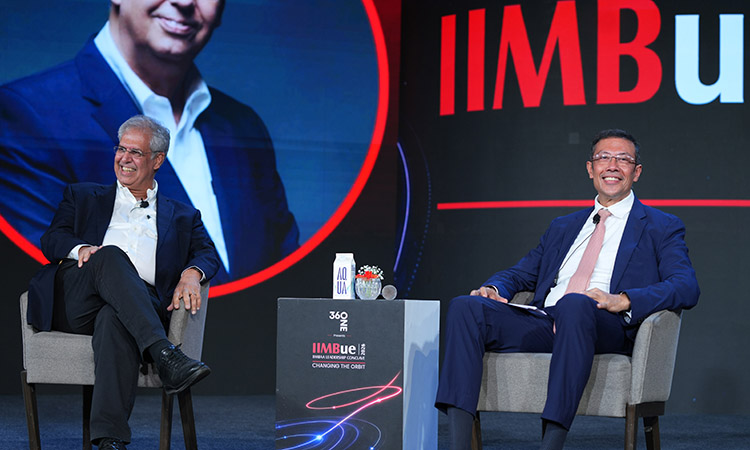
Titans of industry, including Tata Trusts' Noel Tata and Dr. Reddy's G V Prasad, take on diversity, disruption and disorder at IIMBAA’s annual leadership conclave
2 August, 2026, Bengaluru: Day two of IIMBue 2026, the annual leadership conclave organized by the IIM Bangalore Alumni Association (IIMBAA), brought together an eclectic mix of voices for a day of candid conversations on reinvention, resilience and responsible growth. Sessions ranged from panel discussions on inclusion and organizational change to fireside chats on healthcare, philanthropy and geopolitics, providing delegates with a wide-ranging view of the forces reshaping business and society today.
Beyond Diversity: Humans in an Alien World
Day 2 of IIMBue 2026 opened with the panel discussion ‘Beyond Diversity: Humans in an Alien World’, featuring Alina Alam, Founder & CEO, MITTI Café, and Safeena Husain, Founder, Educate Girls, moderated by Prof. Mukta Kulkarni, Dean Programmes and Professor of OBHRM, whose research focuses on workplace inclusion and accessibility.
Highlighting the need to challenge perceptions and patriarchal attitudes, in the country, about both disability and daughters (some actually named ‘Maafi’, ‘Aachuki’, ‘Missed Call’, ‘Reverse Gear’, ‘Faaltu’, ‘Chai-na’, ‘Antim Bala’, ‘Naraazgi’ by their families), Alina and Safeena drew attention to the scale and cost of exclusion, and the crying need for education to be the “unlocker” to opportunity.
Saying she was truly worried about “headwinds (digital divide, closing of govt schools, climate change) that would only worsen the gender divide”, Safina went on to share stories of resilience and grit displayed by girls who are fighting for a second chance. Alina recounted how a staffer on the autism spectrum came up with the brilliant idea of using the resources at the locked-down Mitti cafes, during the peak COVID period, to provide meals to hundreds of hungry migrant workers. Urging people in the room to repay their social debt, Alina called for compassion and courage to lessen differences.
The New Architecture of Growth: How Organizations Reinvent Themselves for a Changing World
The leadership panel on ‘The New Architecture of Growth: How Organizations Reinvent Themselves for a Changing World’ featured IIMB alumni PGP '84 Prof. Das Narayandas, Edsel Bryant Ford Professor of Business Administration, Harvard Business School; PGP '95 Manish Tiwary, Managing Director, Nestlé India; PGP '88 P R Seshadri, MD & CEO, South Indian Bank; and PGP '97 Prabha Narasimhan, MD & CEO, Colgate-Palmolive India.
On the biggest things that leadership must do to stay relevant, the panelists listed reading early signs, reducing the time between decisions and actions, and learning new skills. “Earlier, banks had a monopoly in savings, lending and payments. But they had to adapt to rapid change”, said Seshadri, describing how the sector evolved by identifying emerging needs and building new products. Drawing on his experience across three organizations, Manish observed that Unilever perfected the playbook of scale, Amazon raised the bar on serving the customer, while Nestlé focused on driving institutional good. On technology adoption, particularly AI adoption, Manish argued that it is often leaders who slow technological change. “As leaders, we must be comfortable with change instead of hunkering down and protecting our roles and tasks”.
Prof. Das Narayandas said leaders must first enable their teams to change through reskilling and retooling, before handing over 30-40 per cent of their tasks, along with the decision-making related to such tasks, to these teams. “Working with leaders who move decision-making downwards is indeed the biggest joy”, added Prabha Narasimhan.
Addressing the young professionals in the room, Prof. Das Narayandas advised: “Find a culture, a company or a cause that allows you to fail because through such failure comes learning”.
Asked what they were changing within their own organizations, Manish pointed to digitization, creating hyperlocal environments and rewarding speed over perfection, by design. Seshadri argued that lasting transformation comes from reading the need correctly and building efficiencies through small, palatable changes, over a period, rather than dramatic overhauls. The panel concluded with a shared conviction that the future belongs to the curious and the courageous.
Stars that Shifted Orbits
During the fireside chat titled ‘Stars that Shifted Orbits’, Bhumi Satish Pednekar, Actor, Entrepreneur, UN SDG Advocate and Climate Warrior, spoke with PGP '88 Saif Qureishi, CEO & MD, KRYFS Power Components and Past President, IIMB Alumni Association, about ambition, purpose and reinvention.
Looking back at the decision that shaped her life, Bhumi recalled choosing to become an actor at the age of 12. “I was a gawky but very opinionated teenager. The only place I found solace and peace was on stage because that was the only place where I was positioned way above the school bullies”. Bhumi dwelt on the need to address issues like body shaming and to take roads travelled. “I was thrown out of film school because I took it too lightly and, to enter my dream world of cinema, I began as a casting director at Yash Raj Studio for Rs 7,000 a month. It took a lot of hard work to get my first film (‘Dum Laga Ke Haisha’) from the very same studio. But I got to chase something that was my forte, and I celebrate that”.
Discussing her choice of films with a social purpose, she spoke of how films influence public behaviors (‘Dum Laga Ke Haisha’, ‘Badhaai Ho’) and policies (‘Toilet – Ek Prem Katha’). “I am a very success-hungry person, and I want to leave behind a legacy of genuine and tangible change”. Asked what was harder – the first break or constant reinvention – Bhumi chose reinvention, provided it comes from an “authentic” place.
Speaking on her choice to become an entrepreneur at the peak of her acting career, Bhumi said she wanted to “clean up the beverage space”. She also enrolled in a three-month programme at Harvard Business School when she felt she was plateauing. “I came back rejuvenated and refocused”.
From Molecules to Markets: Scaling Healthcare Across Borders
The fireside chat ‘From Molecules to Markets: Scaling Healthcare Across Borders’ featured G V Prasad, Co-Chairman & MD, Dr. Reddy's Laboratories Ltd, in conversation with PGP '88 Devendra Surana, Managing Director, Bhagyanagar India Ltd.
“More than orbit change to stay relevant, it is about growing adjacencies”, said Prasad, tracing the evolution of Dr Reddy’s Laboratories through the growth of its products, people and culture. “Access and innovation have remained the cornerstones of our business”. According to Prasad, to scale as a global enterprise, the company’s leadership had to learn many things, including understanding legal and regulatory frameworks, and listing and compliance systems, across borders. “Success is also beyond profits. To us, it is about reaching as many patients as possible”.
Speaking of what enables companies to endure, Prasad said fiscal conservatism, creating space for people to fail and learn, and being a learning-oriented organization are important to create resilience, as the potential life span of a company is much larger than the life of a company. “Common sense must prevail over processes”.
From Enterprise to Institution Building: The Tata Philosophy in a Changing India
Opening the fireside chat, PGP '94 Sonjoy Chatterjee, Chairman and CEO, Goldman Sachs India Securities Pvt. Ltd., and Member, Board of Governors, IIM Bangalore, spoke of the exciting chapter ahead for the Institute as it embarks on establishing its Undergraduate School in partnership with the Tata Trusts. He then invited Mr. Noel N. Tata, Chairman, Tata Trusts, to share vignettes from his own journey.
Reflecting on the evolution of Trent, Mr. Tata recalled, “After our sale of Lakmé to Unilever came Trent (from Littlewoods), here in Bangalore. The credit for its success as a retail business goes to my mother, Simone Tata. She invited me to move from Tata International to Trent Limited, and I was employee No. 18. Those were the formative years, and from her we learnt to aim for perfection in everything we did”.
Speaking of some of the toughest decisions in his career, Mr. Tata recounted his decision to position Trent as a private-label business in 1998. “We were, perhaps, the first B2C business in India. We had captured the entire value chain from fabric to customer, but growth was not the function of the number of stores or the locations, but of customer awareness, pricing, and design. The initial years were very slow, and we faced some fire for that!”
Sharing instances of how a business like Trent looked for creative solutions, some truly ingenuous, he also shared his tenets for forging business partnerships. “The chemistry between partners is the most important part of the success of a joint venture. I don't spend as much time on the business case as I do on understanding who my counterparts are and how they manage their business”. Drawing attention to the scale of change in India, he contended, “From thinking of a few stores, we now think in terms of thousands. If we position ourselves correctly, we will address this market well. I learnt from my mother to be the best, and size will follow”.
Mr. Tata described the emotional contrasts of working in the social sector as the head of the Tata Trusts. “The job is to find the most effective allocation of the resources we have, make choices on how to deploy those resources meaningfully, and do what is best for India. We must serve the purpose for which the founders of the Trusts left their shares – to improve life in India”.
He recalled the firsts achieved by the Tata Group and touched upon the Group’s contributions to sectors like energy, power, steel, railways, and more. He also commended the new generation of entrepreneurs in the social sector and said he was impressed with their work but urged them to work on quantifying their impact.
Referring to Tata Trusts' work in setting up cancer hospitals in Assam and general-purpose hospitals in under-resourced parts of the country, he said as Chairman of Tata Trusts, he wanted to bring back the focus on building new institutions. “Our partnership with IIM Bangalore to set up the school of Undergraduate School is a step in this direction. There is a crying need to set up more institutions of excellence in India for our young people”.
The Changing Geopolitical Landscape
In the concluding fireside chat, ‘The Changing Geopolitical Landscape’, Venu Rajamony, Former Ambassador of India to the Netherlands, joined Prof. M.V. Rajeev Gowda, public policy expert, former Member of Parliament and former faculty at IIM Bangalore, for a discussion on an increasingly uncertain global order.
Venu Rajamony made four observations of the world. “We tragically seem to be living in a world where ‘man is wolf unto man’; the old order is over and nostalgia is not a strategy; there are over 130 conflicts raging in various parts of the world – the highest ever since World War 2 – and we are seeing the limits of military power; and multilateralism is in a crisis across the world”.
While countries are turning inward to build resilience, he cautioned that “every country turning into a fortress only makes the world more fragile”. He observed that ‘geopolitics for everyone’ is no longer a distant background but is now affecting everyday lives. “Just like for countries, for business too disruption is no longer a periodic event. Disruption has become systemic and businesses must now prepare to re-route and re-price”. India, he said, has a commodity that is world-class and it is her ‘people’ and their ‘talent’. “Entrepreneurship focused on the domestic economy is the way forward”.
Responding to Prof. Rajeev Gowda's remark on the growing hostility toward "outsiders" in almost all parts of the world, Venu Rajamony acknowledged a rising tide of right-wing sentiment across countries and noted that while there will be some slowdown in the outflow of talent, demand for specialized skills and cutting-edge expertise will always persist.
“I am a firm believer in the philosophy: ‘hide your capabilities, build your strengths’”. India, he suggested, must aim not only for a seat at the high table of geopolitics but must also work at addressing poverty, inequality and climate change. He added that the Indian diaspora must be mobilized – both as an influencer abroad and as a partner in the country's development. Ambassador Rajamony also argued that India and China must learn to manage their relationship with one another, cautioning that treating each other as permanent adversaries serves neither nation well.
Day 1 Recap: Changing the Orbit
IIMBue 2026 opened on 1st August with over 1500 delegates in attendance, as the alumni-led conclave kicked off with addresses from Prof. U Dinesh Kumar, Director-in-charge, IIMB, and Chief Guest Omar Abdullah, Chief Minister of Jammu & Kashmir, who delivered the inaugural keynote on institution-building and long-term development. The day's conversations spanned an eclectic range. Sundeep Sikka provided insights on India-Japan capital flows, Ambassador Deepak Vohra dwelt on India's rise in a multipolar world, while a panel on GCCs navigating the AI era featured leaders from Heineken and Infosys.
The day also brought its share of star power and storytelling: IIMB alumnus PC Musthafa, Chairman & Global CEO of iD Fresh Food, took a live polygraph test on stage while recounting his entrepreneurial journey, and actor Boman Irani held the audience spellbound with a deeply personal account of resilience, reinvention and chasing joy. Siddharth Sharma, CEO of Tata Trusts, closed out the leadership conversations with a keynote on purpose-driven philanthropy, while a panel of deep-tech leaders that brought together voices from Zen Technologies, Micron and L&T Semiconductor explored India's shift from a technology user to technology creator. Day 1 concluded with an expert talk on ISRO's space programme by P. Kunhikrishnan, Former Member, Space Commission; ISRO Distinguished Scientist (Apex).
Click here for photo gallery
Click here for Day 1 release
No nostalgia, no playbook: Day two of IIMBue forces industry to rewrite the rules
Titans of industry, including Tata Trusts' Noel Tata and Dr. Reddy's G V Prasad, take on diversity, disruption and disorder at IIMBAA’s annual leadership conclave
2 August, 2026, Bengaluru: Day two of IIMBue 2026, the annual leadership conclave organized by the IIM Bangalore Alumni Association (IIMBAA), brought together an eclectic mix of voices for a day of candid conversations on reinvention, resilience and responsible growth. Sessions ranged from panel discussions on inclusion and organizational change to fireside chats on healthcare, philanthropy and geopolitics, providing delegates with a wide-ranging view of the forces reshaping business and society today.
Beyond Diversity: Humans in an Alien World
Day 2 of IIMBue 2026 opened with the panel discussion ‘Beyond Diversity: Humans in an Alien World’, featuring Alina Alam, Founder & CEO, MITTI Café, and Safeena Husain, Founder, Educate Girls, moderated by Prof. Mukta Kulkarni, Dean Programmes and Professor of OBHRM, whose research focuses on workplace inclusion and accessibility.
Highlighting the need to challenge perceptions and patriarchal attitudes, in the country, about both disability and daughters (some actually named ‘Maafi’, ‘Aachuki’, ‘Missed Call’, ‘Reverse Gear’, ‘Faaltu’, ‘Chai-na’, ‘Antim Bala’, ‘Naraazgi’ by their families), Alina and Safeena drew attention to the scale and cost of exclusion, and the crying need for education to be the “unlocker” to opportunity.
Saying she was truly worried about “headwinds (digital divide, closing of govt schools, climate change) that would only worsen the gender divide”, Safina went on to share stories of resilience and grit displayed by girls who are fighting for a second chance. Alina recounted how a staffer on the autism spectrum came up with the brilliant idea of using the resources at the locked-down Mitti cafes, during the peak COVID period, to provide meals to hundreds of hungry migrant workers. Urging people in the room to repay their social debt, Alina called for compassion and courage to lessen differences.
The New Architecture of Growth: How Organizations Reinvent Themselves for a Changing World
The leadership panel on ‘The New Architecture of Growth: How Organizations Reinvent Themselves for a Changing World’ featured IIMB alumni PGP '84 Prof. Das Narayandas, Edsel Bryant Ford Professor of Business Administration, Harvard Business School; PGP '95 Manish Tiwary, Managing Director, Nestlé India; PGP '88 P R Seshadri, MD & CEO, South Indian Bank; and PGP '97 Prabha Narasimhan, MD & CEO, Colgate-Palmolive India.
On the biggest things that leadership must do to stay relevant, the panelists listed reading early signs, reducing the time between decisions and actions, and learning new skills. “Earlier, banks had a monopoly in savings, lending and payments. But they had to adapt to rapid change”, said Seshadri, describing how the sector evolved by identifying emerging needs and building new products. Drawing on his experience across three organizations, Manish observed that Unilever perfected the playbook of scale, Amazon raised the bar on serving the customer, while Nestlé focused on driving institutional good. On technology adoption, particularly AI adoption, Manish argued that it is often leaders who slow technological change. “As leaders, we must be comfortable with change instead of hunkering down and protecting our roles and tasks”.
Prof. Das Narayandas said leaders must first enable their teams to change through reskilling and retooling, before handing over 30-40 per cent of their tasks, along with the decision-making related to such tasks, to these teams. “Working with leaders who move decision-making downwards is indeed the biggest joy”, added Prabha Narasimhan.
Addressing the young professionals in the room, Prof. Das Narayandas advised: “Find a culture, a company or a cause that allows you to fail because through such failure comes learning”.
Asked what they were changing within their own organizations, Manish pointed to digitization, creating hyperlocal environments and rewarding speed over perfection, by design. Seshadri argued that lasting transformation comes from reading the need correctly and building efficiencies through small, palatable changes, over a period, rather than dramatic overhauls. The panel concluded with a shared conviction that the future belongs to the curious and the courageous.
Stars that Shifted Orbits
During the fireside chat titled ‘Stars that Shifted Orbits’, Bhumi Satish Pednekar, Actor, Entrepreneur, UN SDG Advocate and Climate Warrior, spoke with PGP '88 Saif Qureishi, CEO & MD, KRYFS Power Components and Past President, IIMB Alumni Association, about ambition, purpose and reinvention.
Looking back at the decision that shaped her life, Bhumi recalled choosing to become an actor at the age of 12. “I was a gawky but very opinionated teenager. The only place I found solace and peace was on stage because that was the only place where I was positioned way above the school bullies”. Bhumi dwelt on the need to address issues like body shaming and to take roads travelled. “I was thrown out of film school because I took it too lightly and, to enter my dream world of cinema, I began as a casting director at Yash Raj Studio for Rs 7,000 a month. It took a lot of hard work to get my first film (‘Dum Laga Ke Haisha’) from the very same studio. But I got to chase something that was my forte, and I celebrate that”.
Discussing her choice of films with a social purpose, she spoke of how films influence public behaviors (‘Dum Laga Ke Haisha’, ‘Badhaai Ho’) and policies (‘Toilet – Ek Prem Katha’). “I am a very success-hungry person, and I want to leave behind a legacy of genuine and tangible change”. Asked what was harder – the first break or constant reinvention – Bhumi chose reinvention, provided it comes from an “authentic” place.
Speaking on her choice to become an entrepreneur at the peak of her acting career, Bhumi said she wanted to “clean up the beverage space”. She also enrolled in a three-month programme at Harvard Business School when she felt she was plateauing. “I came back rejuvenated and refocused”.
From Molecules to Markets: Scaling Healthcare Across Borders
The fireside chat ‘From Molecules to Markets: Scaling Healthcare Across Borders’ featured G V Prasad, Co-Chairman & MD, Dr. Reddy's Laboratories Ltd, in conversation with PGP '88 Devendra Surana, Managing Director, Bhagyanagar India Ltd.
“More than orbit change to stay relevant, it is about growing adjacencies”, said Prasad, tracing the evolution of Dr Reddy’s Laboratories through the growth of its products, people and culture. “Access and innovation have remained the cornerstones of our business”. According to Prasad, to scale as a global enterprise, the company’s leadership had to learn many things, including understanding legal and regulatory frameworks, and listing and compliance systems, across borders. “Success is also beyond profits. To us, it is about reaching as many patients as possible”.
Speaking of what enables companies to endure, Prasad said fiscal conservatism, creating space for people to fail and learn, and being a learning-oriented organization are important to create resilience, as the potential life span of a company is much larger than the life of a company. “Common sense must prevail over processes”.
From Enterprise to Institution Building: The Tata Philosophy in a Changing India
Opening the fireside chat, PGP '94 Sonjoy Chatterjee, Chairman and CEO, Goldman Sachs India Securities Pvt. Ltd., and Member, Board of Governors, IIM Bangalore, spoke of the exciting chapter ahead for the Institute as it embarks on establishing its Undergraduate School in partnership with the Tata Trusts. He then invited Mr. Noel N. Tata, Chairman, Tata Trusts, to share vignettes from his own journey.
Reflecting on the evolution of Trent, Mr. Tata recalled, “After our sale of Lakmé to Unilever came Trent (from Littlewoods), here in Bangalore. The credit for its success as a retail business goes to my mother, Simone Tata. She invited me to move from Tata International to Trent Limited, and I was employee No. 18. Those were the formative years, and from her we learnt to aim for perfection in everything we did”.
Speaking of some of the toughest decisions in his career, Mr. Tata recounted his decision to position Trent as a private-label business in 1998. “We were, perhaps, the first B2C business in India. We had captured the entire value chain from fabric to customer, but growth was not the function of the number of stores or the locations, but of customer awareness, pricing, and design. The initial years were very slow, and we faced some fire for that!”
Sharing instances of how a business like Trent looked for creative solutions, some truly ingenuous, he also shared his tenets for forging business partnerships. “The chemistry between partners is the most important part of the success of a joint venture. I don't spend as much time on the business case as I do on understanding who my counterparts are and how they manage their business”. Drawing attention to the scale of change in India, he contended, “From thinking of a few stores, we now think in terms of thousands. If we position ourselves correctly, we will address this market well. I learnt from my mother to be the best, and size will follow”.
Mr. Tata described the emotional contrasts of working in the social sector as the head of the Tata Trusts. “The job is to find the most effective allocation of the resources we have, make choices on how to deploy those resources meaningfully, and do what is best for India. We must serve the purpose for which the founders of the Trusts left their shares – to improve life in India”.
He recalled the firsts achieved by the Tata Group and touched upon the Group’s contributions to sectors like energy, power, steel, railways, and more. He also commended the new generation of entrepreneurs in the social sector and said he was impressed with their work but urged them to work on quantifying their impact.
Referring to Tata Trusts' work in setting up cancer hospitals in Assam and general-purpose hospitals in under-resourced parts of the country, he said as Chairman of Tata Trusts, he wanted to bring back the focus on building new institutions. “Our partnership with IIM Bangalore to set up the school of Undergraduate School is a step in this direction. There is a crying need to set up more institutions of excellence in India for our young people”.
The Changing Geopolitical Landscape
In the concluding fireside chat, ‘The Changing Geopolitical Landscape’, Venu Rajamony, Former Ambassador of India to the Netherlands, joined Prof. M.V. Rajeev Gowda, public policy expert, former Member of Parliament and former faculty at IIM Bangalore, for a discussion on an increasingly uncertain global order.
Venu Rajamony made four observations of the world. “We tragically seem to be living in a world where ‘man is wolf unto man’; the old order is over and nostalgia is not a strategy; there are over 130 conflicts raging in various parts of the world – the highest ever since World War 2 – and we are seeing the limits of military power; and multilateralism is in a crisis across the world”.
While countries are turning inward to build resilience, he cautioned that “every country turning into a fortress only makes the world more fragile”. He observed that ‘geopolitics for everyone’ is no longer a distant background but is now affecting everyday lives. “Just like for countries, for business too disruption is no longer a periodic event. Disruption has become systemic and businesses must now prepare to re-route and re-price”. India, he said, has a commodity that is world-class and it is her ‘people’ and their ‘talent’. “Entrepreneurship focused on the domestic economy is the way forward”.
Responding to Prof. Rajeev Gowda's remark on the growing hostility toward "outsiders" in almost all parts of the world, Venu Rajamony acknowledged a rising tide of right-wing sentiment across countries and noted that while there will be some slowdown in the outflow of talent, demand for specialized skills and cutting-edge expertise will always persist.
“I am a firm believer in the philosophy: ‘hide your capabilities, build your strengths’”. India, he suggested, must aim not only for a seat at the high table of geopolitics but must also work at addressing poverty, inequality and climate change. He added that the Indian diaspora must be mobilized – both as an influencer abroad and as a partner in the country's development. Ambassador Rajamony also argued that India and China must learn to manage their relationship with one another, cautioning that treating each other as permanent adversaries serves neither nation well.
Day 1 Recap: Changing the Orbit
IIMBue 2026 opened on 1st August with over 1500 delegates in attendance, as the alumni-led conclave kicked off with addresses from Prof. U Dinesh Kumar, Director-in-charge, IIMB, and Chief Guest Omar Abdullah, Chief Minister of Jammu & Kashmir, who delivered the inaugural keynote on institution-building and long-term development. The day's conversations spanned an eclectic range. Sundeep Sikka provided insights on India-Japan capital flows, Ambassador Deepak Vohra dwelt on India's rise in a multipolar world, while a panel on GCCs navigating the AI era featured leaders from Heineken and Infosys.
The day also brought its share of star power and storytelling: IIMB alumnus PC Musthafa, Chairman & Global CEO of iD Fresh Food, took a live polygraph test on stage while recounting his entrepreneurial journey, and actor Boman Irani held the audience spellbound with a deeply personal account of resilience, reinvention and chasing joy. Siddharth Sharma, CEO of Tata Trusts, closed out the leadership conversations with a keynote on purpose-driven philanthropy, while a panel of deep-tech leaders that brought together voices from Zen Technologies, Micron and L&T Semiconductor explored India's shift from a technology user to technology creator. Day 1 concluded with an expert talk on ISRO's space programme by P. Kunhikrishnan, Former Member, Space Commission; ISRO Distinguished Scientist (Apex).
Click here for photo gallery
Click here for Day 1 release