
IIMB hosts third edition of European Foundation for Management Development (EFMD) Symposium in India
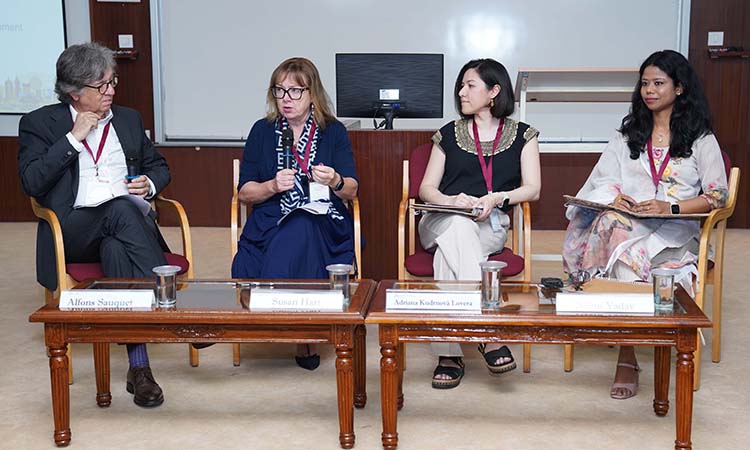
The workshop explored the theme ‘Transformation through accreditation: Leveraging internationalisation, technology and research’
30 April, 2026, Bangalore: IIM Bangalore, in partnership with European Foundation for Management Development (EFMD Global), hosted the third edition of the EFMD Symposium in India, convening speakers from academia and industry to explore the theme, ‘Transformation through accreditation: Leveraging internationalization, technology, and research.’
This workshop brought together senior leaders and academic decision-makers at Indian business schools who are engaged in strategy, quality assurance, and institutional development.
Delivering the opening address, Eric Cornuel, President, EFMD Global, emphasized the importance of global collaboration and shared values in advancing management education. Reflecting on growing engagement with India, he noted, “We are planning several new cooperations together with India. We are far geographically, but close in mind and values. Management education is one of the most powerful ways to bring our regions closer.”
Welcoming the participants, Prof. Mukta Kulkarni, Dean, Programmes, IIM Bangalore, acknowledged the vision of Prof. Rishikesha T. Krishnan, Former Director, IIMB, and Professor In-charge, New Campus, in initiating the symposium and outlined the day’s focus areas spanning teaching, research, and institutional impact.
She highlighted the urgency of rethinking education in the AI era, stating, “This symposium is an opportunity to reflect on how we transform our teaching, research, and impact in response to the classroom, in a world where answers are readily available through AI.”
Nishit Jain, Senior Special Advisor Asia, EFMD Global, described the symposium as part of EFMD’s ongoing efforts to strengthen management education in India through initiatives such as the India Business Council. He emphasized the importance of internationalization beyond mobility, encompassing global mindsets, intercultural learning, and collaborative research ecosystems.
Alfons Sauquet, Director, EQUIS and Quality Services, EFMD Global, reflected on EFMD’s journey in India, which began with a fundamental question on how to contribute meaningfully to the country’s management education landscape. He highlighted the role of the India Business Council as a collaborative platform to enhance global visibility and foster institutional development.
Artificial Intelligence in Management Education: Enhancing Learning Effectiveness and Impact
The panel discussion on the topic, ‘Artificial Intelligence in Management Education: Enhancing Learning Effectiveness and Impact,’ was moderated by Prof. Rishikesha T. Krishnan, Strategy area, IIMB.
He directed the discussion toward the practical applications of AI in management education. He focused the discussion on critical questions about how institutions should integrate AI into classrooms, including whether schools should develop their own AI capabilities, how faculty roles must evolve, and how learning outcomes can be redefined in an AI-enabled environment.
“The key question before us is how artificial intelligence can move from being a tool of efficiency to becoming a meaningful support system for teaching and learning,” he said.
Prof. Rahul Dé, former faculty, Information Systems area, IIMB, and Founder & CEO, Memoric AI, underscored the importance of integrating AI across disciplines while emphasizing the value of human capabilities like empathy, communication, and judgment. He indicated the AI ecosystem's exponential growth, citing a rapid increase in models and usage worldwide. “AI can and should be used across the curriculum, but our responsibility is to ensure every student leaves with strong core knowledge and the ability to use these tools responsibly and effectively.”
He further highlighted that AI is significantly lowering barriers in areas such as simulation, data generation, and content creation, allowing for more dynamic and experiential learning environments while also increasing institutions' responsibility to define what constitutes essential, enduring knowledge.
Rohini Srivathsa, Former CTO, Microsoft South Asia, outlined key technological shifts, including contextual intelligence, multimodal capabilities, and advancing reasoning in AI systems, while emphasizing that organizations must adopt a full-stack approach, spanning models, data, and governance, while addressing critical considerations of accountability, trust, and human agency.
“AI is not accountable, people are. As its capabilities grow, the bar for human judgment, responsibility, and agency becomes significantly higher”, she said.
She additionally insisted on the importance of distinguishing between intelligence and knowledge, arguing that while AI provides scalable intelligence, meaningful applications rely on well-structured knowledge systems.
Karthik Shashidhar, PGDM’ 06, IIMB, and Co-founder & CEO, Babbage Insight, brought a practitioner's perspective on how AI is reshaping both industry expectations and classroom dynamics.
“We must start with the assumption that every student is already using AI, and redesign learning to focus less on information retrieval and far more on critical thinking and decision-making”, he said.
He highlighted that AI is fundamentally altering the efficient frontier of learning, making tasks like data analysis, summarization, and content generation significantly easier, while increasing the relative importance of skills such as contextual understanding, problem framing, and evaluation.
The unpredictability of AI's trajectory emphasizes the importance of educators remaining adaptive and proactive. He noted that faculty must constantly evolve to stay competitive in an environment where students are increasingly AI-enabled.
The symposium emphasized accreditation's role as a catalyst for institutional transformation, as well as the growing convergence of technology, internationalization, and research in shaping management education's future.
Click here for photo gallery
IIMB hosts third edition of European Foundation for Management Development (EFMD) Symposium in India
The workshop explored the theme ‘Transformation through accreditation: Leveraging internationalisation, technology and research’
30 April, 2026, Bangalore: IIM Bangalore, in partnership with European Foundation for Management Development (EFMD Global), hosted the third edition of the EFMD Symposium in India, convening speakers from academia and industry to explore the theme, ‘Transformation through accreditation: Leveraging internationalization, technology, and research.’
This workshop brought together senior leaders and academic decision-makers at Indian business schools who are engaged in strategy, quality assurance, and institutional development.
Delivering the opening address, Eric Cornuel, President, EFMD Global, emphasized the importance of global collaboration and shared values in advancing management education. Reflecting on growing engagement with India, he noted, “We are planning several new cooperations together with India. We are far geographically, but close in mind and values. Management education is one of the most powerful ways to bring our regions closer.”
Welcoming the participants, Prof. Mukta Kulkarni, Dean, Programmes, IIM Bangalore, acknowledged the vision of Prof. Rishikesha T. Krishnan, Former Director, IIMB, and Professor In-charge, New Campus, in initiating the symposium and outlined the day’s focus areas spanning teaching, research, and institutional impact.
She highlighted the urgency of rethinking education in the AI era, stating, “This symposium is an opportunity to reflect on how we transform our teaching, research, and impact in response to the classroom, in a world where answers are readily available through AI.”
Nishit Jain, Senior Special Advisor Asia, EFMD Global, described the symposium as part of EFMD’s ongoing efforts to strengthen management education in India through initiatives such as the India Business Council. He emphasized the importance of internationalization beyond mobility, encompassing global mindsets, intercultural learning, and collaborative research ecosystems.
Alfons Sauquet, Director, EQUIS and Quality Services, EFMD Global, reflected on EFMD’s journey in India, which began with a fundamental question on how to contribute meaningfully to the country’s management education landscape. He highlighted the role of the India Business Council as a collaborative platform to enhance global visibility and foster institutional development.
Artificial Intelligence in Management Education: Enhancing Learning Effectiveness and Impact
The panel discussion on the topic, ‘Artificial Intelligence in Management Education: Enhancing Learning Effectiveness and Impact,’ was moderated by Prof. Rishikesha T. Krishnan, Strategy area, IIMB.
He directed the discussion toward the practical applications of AI in management education. He focused the discussion on critical questions about how institutions should integrate AI into classrooms, including whether schools should develop their own AI capabilities, how faculty roles must evolve, and how learning outcomes can be redefined in an AI-enabled environment.
“The key question before us is how artificial intelligence can move from being a tool of efficiency to becoming a meaningful support system for teaching and learning,” he said.
Prof. Rahul Dé, former faculty, Information Systems area, IIMB, and Founder & CEO, Memoric AI, underscored the importance of integrating AI across disciplines while emphasizing the value of human capabilities like empathy, communication, and judgment. He indicated the AI ecosystem's exponential growth, citing a rapid increase in models and usage worldwide. “AI can and should be used across the curriculum, but our responsibility is to ensure every student leaves with strong core knowledge and the ability to use these tools responsibly and effectively.”
He further highlighted that AI is significantly lowering barriers in areas such as simulation, data generation, and content creation, allowing for more dynamic and experiential learning environments while also increasing institutions' responsibility to define what constitutes essential, enduring knowledge.
Rohini Srivathsa, Former CTO, Microsoft South Asia, outlined key technological shifts, including contextual intelligence, multimodal capabilities, and advancing reasoning in AI systems, while emphasizing that organizations must adopt a full-stack approach, spanning models, data, and governance, while addressing critical considerations of accountability, trust, and human agency.
“AI is not accountable, people are. As its capabilities grow, the bar for human judgment, responsibility, and agency becomes significantly higher”, she said.
She additionally insisted on the importance of distinguishing between intelligence and knowledge, arguing that while AI provides scalable intelligence, meaningful applications rely on well-structured knowledge systems.
Karthik Shashidhar, PGDM’ 06, IIMB, and Co-founder & CEO, Babbage Insight, brought a practitioner's perspective on how AI is reshaping both industry expectations and classroom dynamics.
“We must start with the assumption that every student is already using AI, and redesign learning to focus less on information retrieval and far more on critical thinking and decision-making”, he said.
He highlighted that AI is fundamentally altering the efficient frontier of learning, making tasks like data analysis, summarization, and content generation significantly easier, while increasing the relative importance of skills such as contextual understanding, problem framing, and evaluation.
The unpredictability of AI's trajectory emphasizes the importance of educators remaining adaptive and proactive. He noted that faculty must constantly evolve to stay competitive in an environment where students are increasingly AI-enabled.
The symposium emphasized accreditation's role as a catalyst for institutional transformation, as well as the growing convergence of technology, internationalization, and research in shaping management education's future.
Click here for photo gallery