
CSITM hosts panel discussion on navigating India’s new cyber reality in the age of AI-driven threats
Speakers call for embedding trust, security, and cyber resilience into India’s digital future
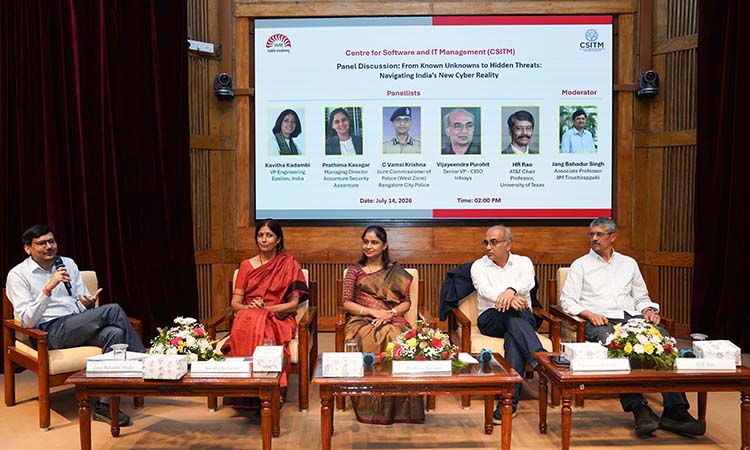
14 July, 2026, Bengaluru: The Centre for Software & IT Management (CSITM) at IIM Bangalore organized a panel discussion titled, ‘From Known Unknowns to Hidden Threats: Navigating India’s New Cyber Reality’, bringing together leaders from industry and academia to unpack a threat landscape moving faster than most organisations can defend against on 14 July, 2026.
Welcome Address
Prof. Mayank Kumar, Chairperson, Centre for Software & Information Technology Management, delivering the welcome address, set the tone by asking whether today's technologies are even equipped to keep pace with the scale of the challenge and explained how the centre acts as the hub for addressing these challenges through research and panel discussions.
Prof. Shankhadeep Banerjee, Chairperson, Information Systems and IT Facilitation Committee, sharpened the point further on cybersecurity; he noted it has quietly shifted from protecting computer machines to protecting people, as AI-generated deepfakes, cloned voices, and fabricated ‘kidnapping’ calls turn human trust itself into the attack surface.
Panel Discussion: From Known Unknowns to Hidden Threats: Navigating India’s New Cyber Reality
Prof. Jang Bahadur Singh, Information Systems and Analytics area, IIM Tiruchirappalli, moderated the panel discussion by framing India's digital rise as a story without precedent: the country skipped landlines and broadband altogether and went straight to mobile. With some of the cheapest data in the world and a demonetisation-and-pandemic push toward digital payments, India now processes over 66 crore UPI transactions a day, accounting for roughly half of all real-time digital payments globally.
Citing data, he added that the same speed that built this ecosystem has left gaps: over 20 lakh cybercrime complaints were filed last year, with losses touching ₹22,000 crore, a tenfold jump in three years, while enforcement has managed to recover barely ₹60 crore of it.
Kavitha Kadambi, Vice President Engineering, Epsilon, India, spoke about how India has moved from being a services hub to an engineering powerhouse, noting that most products built for India, and a significant share built for the world, are now engineered here. On security, she said, it cannot be "bolted on"; it must be designed in from the architecture stage, especially as connected cars and IoT devices generate zettabytes of data that demand consent, anonymisation, and strict access control.
Vijayeendra Purohit, Senior Vice President and Chief Information Security Officer (CISO), Infosys, delivered the discussion's sharpest statistic: that the fastest recorded breach last year took just 27 seconds, with average attack time falling from 52 seconds to 25. "Speed is the new defence," he said, arguing that security today must operate at machine speed, not wire speed. He urged the audience to rethink basic habits by never sharing your real date of birth online and never reusing passwords across apps.
"We do not know how the fraudsters weaponize trust," he said, arguing that digital India needs the same kind of trust architecture that dairy brands built over decades.
He also shared field research from Ghana, where romance scammers were identified by the fancy cars in a cyber café's parking lot, a reminder that fraud today exploits fear, urgency, authority, and even romantic trust, not just ignorance. He concluded the discussion by saying, "Awareness matters, but knowledge is not sufficient to overcome pressure in the moment.”
Speaking to the largely student and research audience, Purohit called for building threat-intelligence-driven awareness that reaches even a small-town startup. Kavitha Kadambi urged India to move beyond the digital economy and the creative economy towards the trust economy. Kasagar recommended treating every business decision as a security decision. And Prof. Rao made the case for cybersecurity to be taught not as a technical elective, but as a core leadership competency in business schools.
The panel closed with a quick, rapid-fire round and Q&A.
Click here for photo gallery
CSITM hosts panel discussion on navigating India’s new cyber reality in the age of AI-driven threats
Speakers call for embedding trust, security, and cyber resilience into India’s digital future
14 July, 2026, Bengaluru: The Centre for Software & IT Management (CSITM) at IIM Bangalore organized a panel discussion titled, ‘From Known Unknowns to Hidden Threats: Navigating India’s New Cyber Reality’, bringing together leaders from industry and academia to unpack a threat landscape moving faster than most organisations can defend against on 14 July, 2026.
Welcome Address
Prof. Mayank Kumar, Chairperson, Centre for Software & Information Technology Management, delivering the welcome address, set the tone by asking whether today's technologies are even equipped to keep pace with the scale of the challenge and explained how the centre acts as the hub for addressing these challenges through research and panel discussions.
Prof. Shankhadeep Banerjee, Chairperson, Information Systems and IT Facilitation Committee, sharpened the point further on cybersecurity; he noted it has quietly shifted from protecting computer machines to protecting people, as AI-generated deepfakes, cloned voices, and fabricated ‘kidnapping’ calls turn human trust itself into the attack surface.
Panel Discussion: From Known Unknowns to Hidden Threats: Navigating India’s New Cyber Reality
Prof. Jang Bahadur Singh, Information Systems and Analytics area, IIM Tiruchirappalli, moderated the panel discussion by framing India's digital rise as a story without precedent: the country skipped landlines and broadband altogether and went straight to mobile. With some of the cheapest data in the world and a demonetisation-and-pandemic push toward digital payments, India now processes over 66 crore UPI transactions a day, accounting for roughly half of all real-time digital payments globally.
Citing data, he added that the same speed that built this ecosystem has left gaps: over 20 lakh cybercrime complaints were filed last year, with losses touching ₹22,000 crore, a tenfold jump in three years, while enforcement has managed to recover barely ₹60 crore of it.
Kavitha Kadambi, Vice President Engineering, Epsilon, India, spoke about how India has moved from being a services hub to an engineering powerhouse, noting that most products built for India, and a significant share built for the world, are now engineered here. On security, she said, it cannot be "bolted on"; it must be designed in from the architecture stage, especially as connected cars and IoT devices generate zettabytes of data that demand consent, anonymisation, and strict access control.
Vijayeendra Purohit, Senior Vice President and Chief Information Security Officer (CISO), Infosys, delivered the discussion's sharpest statistic: that the fastest recorded breach last year took just 27 seconds, with average attack time falling from 52 seconds to 25. "Speed is the new defence," he said, arguing that security today must operate at machine speed, not wire speed. He urged the audience to rethink basic habits by never sharing your real date of birth online and never reusing passwords across apps.
"We do not know how the fraudsters weaponize trust," he said, arguing that digital India needs the same kind of trust architecture that dairy brands built over decades.
He also shared field research from Ghana, where romance scammers were identified by the fancy cars in a cyber café's parking lot, a reminder that fraud today exploits fear, urgency, authority, and even romantic trust, not just ignorance. He concluded the discussion by saying, "Awareness matters, but knowledge is not sufficient to overcome pressure in the moment.”
Speaking to the largely student and research audience, Purohit called for building threat-intelligence-driven awareness that reaches even a small-town startup. Kavitha Kadambi urged India to move beyond the digital economy and the creative economy towards the trust economy. Kasagar recommended treating every business decision as a security decision. And Prof. Rao made the case for cybersecurity to be taught not as a technical elective, but as a core leadership competency in business schools.
The panel closed with a quick, rapid-fire round and Q&A.
Click here for photo gallery