
Centre for Public Policy marks 26th Foundation Day with lecture on modernising India's statistics system
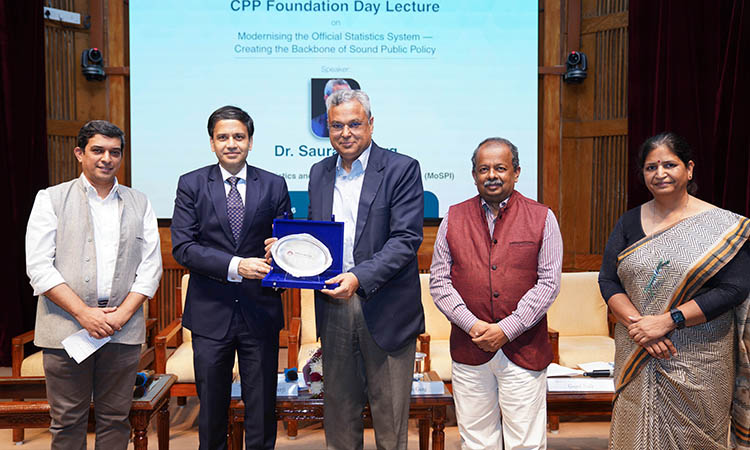
Dr. Saurabh Garg, Secretary, Ministry of Statistics and Programme Implementation, delivers the Eighth Foundation Day Lecture at IIM Bangalore
09 July, 2026, Bengaluru: "The way the data is collected, the way the data is compiled, that ultimately determines how a country is viewed by people, both domestically and outside," observed Dr. Saurabh Garg, Secretary, Ministry of Statistics and Programme Implementation (MoSPI), Government of India, while delivering the 8th lecture of the CPP Foundation Day Lecture Series earlier today, on the topic: 'Modernising the Official Statistics System — Creating the Backbone of Sound Public Policy'. The event was hosted by the Centre for Public Policy (CPP) at IIM Bangalore, marking the Centre's 26th Foundation Day.
Tracing the evolution of India's statistics system, Dr. Garg described how official data draws on three broad sources: census, surveys, and administrative data. "Census has been there perhaps the oldest; the population census dates back as far as 1871," he said, noting that India also conducts census of its economic activity, and its livestock, agriculture, and irrigation.
Further, surveys fill the gaps left by the infrequency of census exercises: "Surveys started in the 1950s in India by Professor P. C. Mahalanobis; he is in fact the pioneer who started the sample surveys globally." He added that administrative data, sourced from tax records, social security, and welfare programmes, has become ‘increasingly important’ over the last decade, powered by the spread of digital infrastructure.
Situating this data infrastructure within India's Viksit Bharat @2047 vision, Dr. Garg noted that its most ambitious goals are zero poverty, universal quality school education, 70% female labour force participation, and a fully skilled workforce in meaningful employment- all depend on robust, timely data to track progress and course-correct.
"Data is not just an asset; it is fast becoming a factor of production, especially given the fact that data is the raw material for artificial intelligence," he said.
Looking ahead, Dr. Garg outlined the priorities shaping the modernisation of India's statistics system: improving the timeliness, frequency, and granularity of data, broadening its diversity with new indices for sectors like services, and building metadata standards and interoperable identifiers so administrative data can be used more effectively for policymaking, all while preserving privacy and confidentiality safeguards.
He pointed to Ayushman Bharat–Pradhan Mantri Jan Arogya Yojana, PM Mudra, Gati Shakti, Digi Yatra, and Unified family registries as examples of how data is already reshaping citizen service delivery, noting that unified family registries have cut scheme rollout times from nearly a year to just eight to ten weeks in some states.
"The key to any data is obviously how it helps citizen service delivery," he said. "If it doesn't help them, then any government would really not be interested in the data."
Earlier during the event, Prof. Gopal Naik, Senior Fellow, and Chairperson Centre for Public Policy , delivered the welcome address and introduced the Centre's work over the past 26 years. He noted that the Post Graduate Programme in Public Policy and Management (PGPPM), launched in 2002, has graduated nearly 500 civil service officers across twenty batches, many of whom have gone on to senior positions across government. He also announced that CPP's 21st International Conference on Public Policy and Management will be held from 2–4 September 2026, themed on Atmanirbhar Bharat in line with the vision of Viksit Bharat.
Prof. Sourav Mukherji, Dean, Faculty, IIM Bangalore, welcomed the chief guest and reflected on the institute's own journey. He expressed hope that research from the Centre would continue to translate into public policy that changes this country in a very positive way, and observed that in an age of artificial intelligence, it is only the policies that will actually save humanity from completely losing what they are valued for.
Prof. Arnab Mukherji, Chairperson, Master of Management Studies (Public Policy), PGPPM, moderated the event's Q&A session. He raised a question on how the government is strengthening learning systems to ensure that evidence and data continuously improve policymaking and institutional capacity. Dr. Garg highlighted initiatives such as the Capacity Building Commission, emphasising the government's focus on continuous learning and collaboration with academic institutions like IIM Bangalore.
In her vote of thanks, Dr. Anjana Dube, Chief Policy Officer at the Centre for Public Policy, expressed gratitude to the speaker, Dr. Garg, for delivering an insightful Foundation Day Lecture on the importance of robust official statistics in enabling evidence-based public policy and informed decision-making.
Click here for photo gallery
Centre for Public Policy marks 26th Foundation Day with lecture on modernising India's statistics system
Dr. Saurabh Garg, Secretary, Ministry of Statistics and Programme Implementation, delivers the Eighth Foundation Day Lecture at IIM Bangalore
09 July, 2026, Bengaluru: "The way the data is collected, the way the data is compiled, that ultimately determines how a country is viewed by people, both domestically and outside," observed Dr. Saurabh Garg, Secretary, Ministry of Statistics and Programme Implementation (MoSPI), Government of India, while delivering the 8th lecture of the CPP Foundation Day Lecture Series earlier today, on the topic: 'Modernising the Official Statistics System — Creating the Backbone of Sound Public Policy'. The event was hosted by the Centre for Public Policy (CPP) at IIM Bangalore, marking the Centre's 26th Foundation Day.
Tracing the evolution of India's statistics system, Dr. Garg described how official data draws on three broad sources: census, surveys, and administrative data. "Census has been there perhaps the oldest; the population census dates back as far as 1871," he said, noting that India also conducts census of its economic activity, and its livestock, agriculture, and irrigation.
Further, surveys fill the gaps left by the infrequency of census exercises: "Surveys started in the 1950s in India by Professor P. C. Mahalanobis; he is in fact the pioneer who started the sample surveys globally." He added that administrative data, sourced from tax records, social security, and welfare programmes, has become ‘increasingly important’ over the last decade, powered by the spread of digital infrastructure.
Situating this data infrastructure within India's Viksit Bharat @2047 vision, Dr. Garg noted that its most ambitious goals are zero poverty, universal quality school education, 70% female labour force participation, and a fully skilled workforce in meaningful employment- all depend on robust, timely data to track progress and course-correct.
"Data is not just an asset; it is fast becoming a factor of production, especially given the fact that data is the raw material for artificial intelligence," he said.
Looking ahead, Dr. Garg outlined the priorities shaping the modernisation of India's statistics system: improving the timeliness, frequency, and granularity of data, broadening its diversity with new indices for sectors like services, and building metadata standards and interoperable identifiers so administrative data can be used more effectively for policymaking, all while preserving privacy and confidentiality safeguards.
He pointed to Ayushman Bharat–Pradhan Mantri Jan Arogya Yojana, PM Mudra, Gati Shakti, Digi Yatra, and Unified family registries as examples of how data is already reshaping citizen service delivery, noting that unified family registries have cut scheme rollout times from nearly a year to just eight to ten weeks in some states.
"The key to any data is obviously how it helps citizen service delivery," he said. "If it doesn't help them, then any government would really not be interested in the data."
Earlier during the event, Prof. Gopal Naik, Senior Fellow, and Chairperson Centre for Public Policy , delivered the welcome address and introduced the Centre's work over the past 26 years. He noted that the Post Graduate Programme in Public Policy and Management (PGPPM), launched in 2002, has graduated nearly 500 civil service officers across twenty batches, many of whom have gone on to senior positions across government. He also announced that CPP's 21st International Conference on Public Policy and Management will be held from 2–4 September 2026, themed on Atmanirbhar Bharat in line with the vision of Viksit Bharat.
Prof. Sourav Mukherji, Dean, Faculty, IIM Bangalore, welcomed the chief guest and reflected on the institute's own journey. He expressed hope that research from the Centre would continue to translate into public policy that changes this country in a very positive way, and observed that in an age of artificial intelligence, it is only the policies that will actually save humanity from completely losing what they are valued for.
Prof. Arnab Mukherji, Chairperson, Master of Management Studies (Public Policy), PGPPM, moderated the event's Q&A session. He raised a question on how the government is strengthening learning systems to ensure that evidence and data continuously improve policymaking and institutional capacity. Dr. Garg highlighted initiatives such as the Capacity Building Commission, emphasising the government's focus on continuous learning and collaboration with academic institutions like IIM Bangalore.
In her vote of thanks, Dr. Anjana Dube, Chief Policy Officer at the Centre for Public Policy, expressed gratitude to the speaker, Dr. Garg, for delivering an insightful Foundation Day Lecture on the importance of robust official statistics in enabling evidence-based public policy and informed decision-making.
Click here for photo gallery