
AI in Research & Writing: Copyright & Ethical Implications
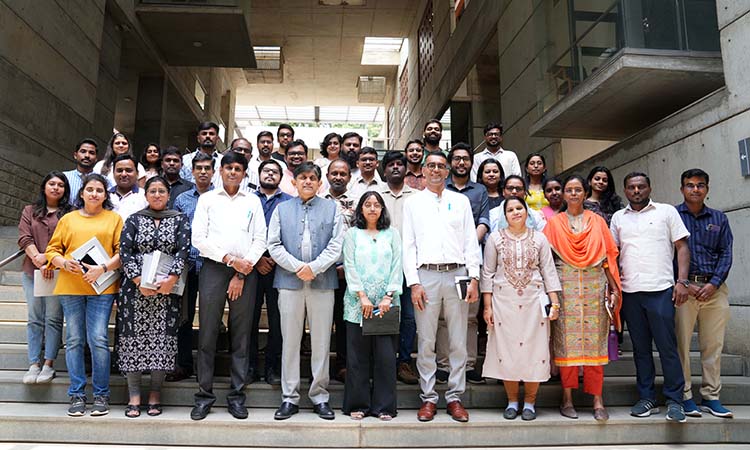
Prof. Anil B Suraj urges scholars to value originality and academic integrity and suggests that universities investigate concerns around equitable access while also implementing an honor code
23 April, 2026, Bengaluru: To mark World Book & Copyright Day, the IIMB Library hosted an insightful seminar on ‘AI in Research and Writing with a special focus on copyright and ethical implications’ by Prof. Anil B Suraj, a legal expert on IPR & Governance, and Professor of Practice, Public Policy area at IIM Bangalore.
In his opening remarks, Prof. Apurva Sanaria, Chairperson of the IIMB Library Committee, observed that in a scenario where AI has become all-pervading in classrooms, copyright assumes significance. “Was the research idea yours and enhanced by AI or vice-versa?” Drawing attention to the AI policy at the Institute, he advised students to err on the side of caution, especially when submitting research papers to journals.
Taking the audience of researchers and practitioners, from India and abroad, through his presentation, Prof. AB Suraj emphasized the need to engage with AI, mindfully. “We need to examine AI in research in the context of whether it enables the growth of human intellect and redraws the limits of fair use.” Defining ‘artificial’ in the context of AI, as “made by humans and to imitate human-like actions in order to assist, support and further the frontiers of human welfare”, he said AI is designed to feed on existing data and synthesize data from assorted sources. He touched upon the threats of hallucinations and amplification of “dark patterns” caused by bias and was confident that such threats would recede with time.
Diving into the topic for discussion, he said AI does help students in overcoming language and accessibility issues, creating quick summaries and drafts, literature review and identification of research gaps, data analysis, and grammar and style.
“But is AI capable of creative and diverse strands of thought? The jury is still out on that,” he remarked. He added that AI has an ‘equalizing’ or ‘scholarly deskilling effect’, referencing research studies conducted in several universities. “As a research scholar, one should look beyond the obvious. What is ‘stated’ or ‘obvious’ will not get you a patent.” He also highlighted that B-schools and universities should investigate concerns around equitable access and implement an honor code on the use of AI.
Prof. AB Suraj exhorted students to value originality and scholarship, and academic integrity. On the scope of copyrights, he explained that obtaining permission from the source (author/ publisher) to cite is necessary, and crediting the source is not enough. “Open Source also asserts copyrights, so be mindful when using it.” He then talked of ‘fair use’ of copyrights, where in India, teaching and education and some activities of libraries, subject to interpretation of the P-A-I-N (purpose, amount, impact and nature of the work) framework, have been listed for concessions.
“There is a lot of debate on whether AI content is copyrightable, and we are yet to hear the last word on whether AI-created content is transformative enough to claim its own originality,” he said.
He concluded by highlighting IIM Bangalore’s AI-use policy and said libraries can play a key role in developing licenses and user conditions, and models for ethical use of AI.
The seminar was conceptualized and organized by Dr Anjaneya Reddy, Deputy Librarian, IIMB, and his team.
AI in Research & Writing: Copyright & Ethical Implications
Prof. Anil B Suraj urges scholars to value originality and academic integrity and suggests that universities investigate concerns around equitable access while also implementing an honor code
23 April, 2026, Bengaluru: To mark World Book & Copyright Day, the IIMB Library hosted an insightful seminar on ‘AI in Research and Writing with a special focus on copyright and ethical implications’ by Prof. Anil B Suraj, a legal expert on IPR & Governance, and Professor of Practice, Public Policy area at IIM Bangalore.
In his opening remarks, Prof. Apurva Sanaria, Chairperson of the IIMB Library Committee, observed that in a scenario where AI has become all-pervading in classrooms, copyright assumes significance. “Was the research idea yours and enhanced by AI or vice-versa?” Drawing attention to the AI policy at the Institute, he advised students to err on the side of caution, especially when submitting research papers to journals.
Taking the audience of researchers and practitioners, from India and abroad, through his presentation, Prof. AB Suraj emphasized the need to engage with AI, mindfully. “We need to examine AI in research in the context of whether it enables the growth of human intellect and redraws the limits of fair use.” Defining ‘artificial’ in the context of AI, as “made by humans and to imitate human-like actions in order to assist, support and further the frontiers of human welfare”, he said AI is designed to feed on existing data and synthesize data from assorted sources. He touched upon the threats of hallucinations and amplification of “dark patterns” caused by bias and was confident that such threats would recede with time.
Diving into the topic for discussion, he said AI does help students in overcoming language and accessibility issues, creating quick summaries and drafts, literature review and identification of research gaps, data analysis, and grammar and style.
“But is AI capable of creative and diverse strands of thought? The jury is still out on that,” he remarked. He added that AI has an ‘equalizing’ or ‘scholarly deskilling effect’, referencing research studies conducted in several universities. “As a research scholar, one should look beyond the obvious. What is ‘stated’ or ‘obvious’ will not get you a patent.” He also highlighted that B-schools and universities should investigate concerns around equitable access and implement an honor code on the use of AI.
Prof. AB Suraj exhorted students to value originality and scholarship, and academic integrity. On the scope of copyrights, he explained that obtaining permission from the source (author/ publisher) to cite is necessary, and crediting the source is not enough. “Open Source also asserts copyrights, so be mindful when using it.” He then talked of ‘fair use’ of copyrights, where in India, teaching and education and some activities of libraries, subject to interpretation of the P-A-I-N (purpose, amount, impact and nature of the work) framework, have been listed for concessions.
“There is a lot of debate on whether AI content is copyrightable, and we are yet to hear the last word on whether AI-created content is transformative enough to claim its own originality,” he said.
He concluded by highlighting IIM Bangalore’s AI-use policy and said libraries can play a key role in developing licenses and user conditions, and models for ethical use of AI.
The seminar was conceptualized and organized by Dr Anjaneya Reddy, Deputy Librarian, IIMB, and his team.