
PRAVAH – Empower 2.0 equips educators to design the next generation of digital learning experiences
IIMBx's two-day Faculty Development Programme at IIM Bangalore explored AI, digital pedagogy and practical approaches to building engaging online courses
20th July, 2026, Bengaluru: How should educators rethink their approach to teaching in an age where artificial intelligence has fundamentally reshaped how knowledge is created, delivered and consumed? This question lay at the heart of PRAVAH – Empower 2.0, a two-day Faculty Development Programme organized by the IIMBx Digital Learning Foundation on 17th & 18th July, which brought together faculty from institutions across the country to examine the changing landscape of digital education.
Day one opened with a keynote by Prof. S. Sadagopan, Founder Director, IIIT Bangalore, who reflected on the need to take knowledge beyond classroom walls and observed that, while AI is here to stay, it could never replace human intellect. "We are naturally intelligent people; we are soon to get tired of AI", he said.
A session featuring Prof. Rahul De’, former faculty of Information Systems, IIM Bangalore, and Prof. G. Shainesh, Chairperson, Digital Learning and faculty of Marketing, examined the educator's role in the age of AI. The discussion explored the opportunities and limitations of generative AI, including AI-generated misinformation and fabricated references, and the need for comprehensive policies at the institute, programme and course levels to guide the responsible use of AI in teaching, learning and assessment.
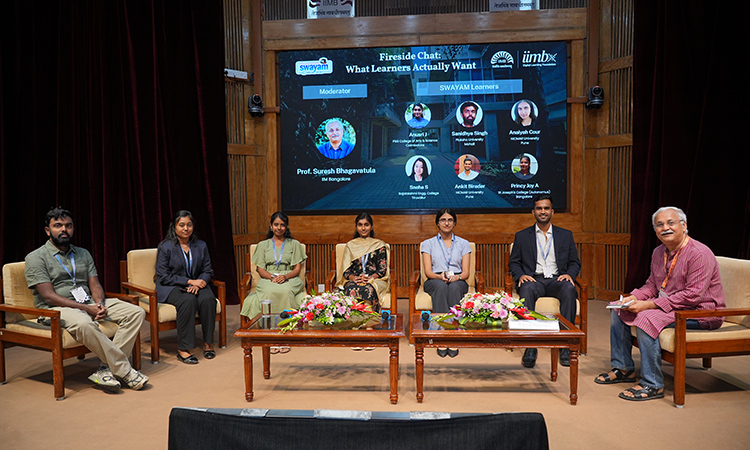
The programme also featured a fireside conversation titled 'What Learners Actually Want', moderated by Prof. Suresh Bhagavatula, Chairperson, BBA in Digital Business and Entrepreneurship (BBA DBE) and faculty of Entrepreneurship, with six top-performing SWAYAM learners – Anusri J, PSG College of Arts & Science; Sanidhya Singh, Plaksha University, Mohali; Anaiyah Cour, NICMAR University, Pune; Sneha S, Rajalakshmi Engg. College, Tiruvallur; Ankit Biradar, NICMAR University; and Princy Joy A, St. Joseph’s College (Autonomous), Bangalore. Drawing on their experiences, the discussion explored elements such as interactive course design, industry relevance, evidence-based pedagogy and learner engagement that contribute to making online learning meaningful.
The second day shifted from discussion to application, with participants engaging in hands-on sessions on course architecture, AI-assisted content development and digital production workflows. Faculty explored how to structure subject expertise into engaging learning experiences, use AI to support scripting and assessments, and understand the end-to-end process of creating publish-ready online course modules.
Designed for educators looking to build and deliver high-quality online courses, PRAVAH – Empower 2.0 combined expert-led discussions with practical workshops, equipping participants with the skills and frameworks needed to create engaging, learner-centric digital learning experiences. The programme also fostered a growing community of educators committed to advancing excellence in online and blended education through the SANGAM network.
PRAVAH – Empower 2.0 equips educators to design the next generation of digital learning experiences
IIMBx's two-day Faculty Development Programme at IIM Bangalore explored AI, digital pedagogy and practical approaches to building engaging online courses
20th July, 2026, Bengaluru: How should educators rethink their approach to teaching in an age where artificial intelligence has fundamentally reshaped how knowledge is created, delivered and consumed? This question lay at the heart of PRAVAH – Empower 2.0, a two-day Faculty Development Programme organized by the IIMBx Digital Learning Foundation on 17th & 18th July, which brought together faculty from institutions across the country to examine the changing landscape of digital education.
Day one opened with a keynote by Prof. S. Sadagopan, Founder Director, IIIT Bangalore, who reflected on the need to take knowledge beyond classroom walls and observed that, while AI is here to stay, it could never replace human intellect. "We are naturally intelligent people; we are soon to get tired of AI", he said.
A session featuring Prof. Rahul De’, former faculty of Information Systems, IIM Bangalore, and Prof. G. Shainesh, Chairperson, Digital Learning and faculty of Marketing, examined the educator's role in the age of AI. The discussion explored the opportunities and limitations of generative AI, including AI-generated misinformation and fabricated references, and the need for comprehensive policies at the institute, programme and course levels to guide the responsible use of AI in teaching, learning and assessment.
The programme also featured a fireside conversation titled 'What Learners Actually Want', moderated by Prof. Suresh Bhagavatula, Chairperson, BBA in Digital Business and Entrepreneurship (BBA DBE) and faculty of Entrepreneurship, with six top-performing SWAYAM learners – Anusri J, PSG College of Arts & Science; Sanidhya Singh, Plaksha University, Mohali; Anaiyah Cour, NICMAR University, Pune; Sneha S, Rajalakshmi Engg. College, Tiruvallur; Ankit Biradar, NICMAR University; and Princy Joy A, St. Joseph’s College (Autonomous), Bangalore. Drawing on their experiences, the discussion explored elements such as interactive course design, industry relevance, evidence-based pedagogy and learner engagement that contribute to making online learning meaningful.
The second day shifted from discussion to application, with participants engaging in hands-on sessions on course architecture, AI-assisted content development and digital production workflows. Faculty explored how to structure subject expertise into engaging learning experiences, use AI to support scripting and assessments, and understand the end-to-end process of creating publish-ready online course modules.
Designed for educators looking to build and deliver high-quality online courses, PRAVAH – Empower 2.0 combined expert-led discussions with practical workshops, equipping participants with the skills and frameworks needed to create engaging, learner-centric digital learning experiences. The programme also fostered a growing community of educators committed to advancing excellence in online and blended education through the SANGAM network.