
Six-day Summer Research Methodology Workshop at IIMB concludes with focus on rigour, relevance and publication readiness
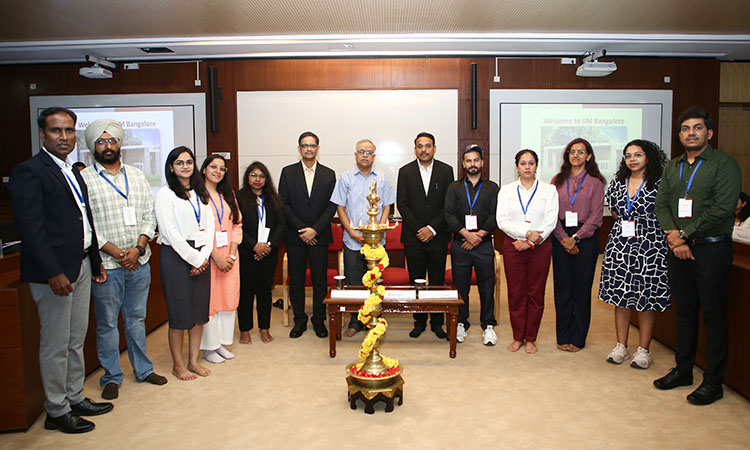
The annual workshop series was hosted by the Research and Publications Office from 20 to 25 April 2026
28 April, 2026, Bengaluru: The Summer Research Methodology Workshop 2026, hosted by the Office of Research & Publications at IIMB, concluded on 25th April, bringing to a close a week of intensive engagement with research practice and design.
The workshop brought together 93 scholars, including academic researchers, PhD scholars and early-career faculty representing diverse academic backgrounds and management institutes across the country. Designed as a capacity-building initiative, the programme focused on strengthening the foundations of rigorous and meaningful research.
Over six days, participants engaged in training across two specialized tracks focusing on qualitative and quantitative methodologies.
The Programme Directors were Prof. Sushanta Kumar Mishra, Chairperson of Research & Publications, C-DOCTA, Executive Education Programmes and the Centre for Teaching & Learning, Editor-in-Chief of IIMB Management Review, and faculty of the Organizational Behavior & Human Resources Management area, and Prof. Deepak Chandrashekar of the Strategy area.
Valedictory address
Prof. U Dinesh Kumar, Director-in-charge, IIMB, spoke of ‘Strategic Applications’ during the valedictory address, highlighting the importance of rigour in academic research in an increasingly AI-driven landscape. “Many journals now require disclosure of AI use. While AI can help build a narrative, papers are often rejected for weak theory or inappropriate methodology”, he said.
He emphasized that the goal should be to secure a revise-and-resubmit decision, while reminding participants to use AI carefully. He noted that AI is a processing model that may provide incorrect answers with high confidence, making it important for researchers to verify its outputs critically. He further observed that publishing in top-tier journals requires expertise drawn from different disciplines and domains.
In his concluding remarks, he expressed hope that the network built through the workshop would help participants publish impactful papers in leading journals and wished them continued success.
Editors’ Roundtable
The concluding day featured an Editors’ Panel that centered on developing research for publication. The session featured Prof. Dalhia Mani, Entrepreneurship area; Prof. Sankarshan Basu, Finance & Accounting area; and Programme Directors Prof. Sushanta Kumar Mishra and Prof. Deepak Chandrashekar, who delved into the fundamentals of journal publishing and shared perspectives on navigating the process and refining scholarly work.
Moderating the session, Prof. Deepak Chandrashekar explained the fundamentals of journal publishing, saying, “Authors should ensure their paper fits the journal, clearly shows its contribution, and is well presented, since editors handle a large number of submissions through strict desk screening”.
Prof. Sushanta Kumar Mishra engaged the group by emphasizing that authors may briefly contact editors after Revise & Resubmit to seek clarity on review feedback. He said, “Rejected papers should be carefully revised before resubmission, with a concise cover letter showing their relevance and better alignment with the new target journal’s specific audience”.
Prof. Sankarshan Basu urged scholars to prioritize pre-submission intelligence to avoid unnecessary delays and advised the participants to match the manuscript to the journal’s specific scope. This, he said, creates a symbiotic relationship that supports the journal’s objectives and significantly improves its chances of consideration.
Prof. Dalhia Mani emphasized that papers should be optimized for review by aligning with journal objectives, easing the burden on reviewers, and ensuring readability, as these factors significantly influence the review cycle and outcomes. “A paper must not only fit the topic but also align with the journal’s preferred methodological rigor and theoretical depth”, she clarified.
Valediction
The Summer Research Methodology Workshop 2026 came to a close, achieving its objective of strengthening research capability by equipping participants with practical skills, methodological grounding and insights into academic publishing.
Summarising the five-day workshop, Prof. Sushanta Kumar Mishra reflected on the depth of engagement and the importance of lasting rigour in research. The session concluded with a vote of thanks delivered by Prof. Deepak Chandrashekar.
The event concluded with all the candidates receiving a Certificate of Participation from IIM Bangalore for the successful completion of the workshop.
About Summer Research Methodology Workshop 2026
IIMB hosted the inauguration of its Summer Research Methodology Workshop 2026 on 20th April, organized by the Office of Research & Publications, bringing together 93 participants of diverse academic backgrounds from across the country.
The week-long programme from 20th to 25th April was designed to strengthen research capabilities among PhD scholars, early-career faculty and academic researchers.
In his inaugural address, Prof. M Jayadev, Dean Administration, Chairperson, Centre for Capital Markets & Risk Management and faculty of the Finance & Accounting area, underlined the evolving role of research in India, noting that pursuing a PhD involves going beyond meeting mere regulatory benchmarks. He said generating credible, relevant and globally competitive knowledge is equally important to tackle complex and specific management problems. He also highlighted the importance of technological agility and the centrality of trust in academic work.
The workshop consisted of two tracks, with Track 1 dedicated to sessions on Qualitative Comparative Analysis and Network Analysis, and Track 2 consisting of sessions on Event Study Methodology, Applied Econometrics and Difference-in-Differences. Both tracks comprised common sessions on qualitative and quantitative methods, experimental design and meta-analysis.
The six-day conference included sessions on Foundations of Social Science Research by Prof. Sushanta K Mishra; Qualitative Research by Prof. Mukta Kulkarni, Dean Programmes, Chairperson, Office of International Affairs and faculty of the OBHRM area; Meta Analysis by Prof. Sai Chittaranjan Kalubandi, Strategy area; Experiment Design by Prof. Arpita Pandey, Marketing area; Quantitative Methods by Prof. Jitamitra Desai, Decision Sciences area; Qualitative Comparative Analysis by Prof. Ramya K Murthy, Entrepreneurship area; Network Analysis by Prof. Dalhia Mani, Chairperson and faculty, Entrepreneurship area; Event Study Methodology by Prof. Varun Jindal, Finance & Accounting area; Applied Econometrics by Prof. Sumit Saurav, Finance & Accounting area; and Impact Evolution: Quasi-Experimental Methods, with focus on Difference-in-Differences, by Prof. Maya Ganesh, Production & Operations Management area.
Click here for photo gallery
Click here for the inauguration story.
Six-day Summer Research Methodology Workshop at IIMB concludes with focus on rigour, relevance and publication readiness
The annual workshop series was hosted by the Research and Publications Office from 20 to 25 April 2026
28 April, 2026, Bengaluru: The Summer Research Methodology Workshop 2026, hosted by the Office of Research & Publications at IIMB, concluded on 25th April, bringing to a close a week of intensive engagement with research practice and design.
The workshop brought together 93 scholars, including academic researchers, PhD scholars and early-career faculty representing diverse academic backgrounds and management institutes across the country. Designed as a capacity-building initiative, the programme focused on strengthening the foundations of rigorous and meaningful research.
Over six days, participants engaged in training across two specialized tracks focusing on qualitative and quantitative methodologies.
The Programme Directors were Prof. Sushanta Kumar Mishra, Chairperson of Research & Publications, C-DOCTA, Executive Education Programmes and the Centre for Teaching & Learning, Editor-in-Chief of IIMB Management Review, and faculty of the Organizational Behavior & Human Resources Management area, and Prof. Deepak Chandrashekar of the Strategy area.
Valedictory address
Prof. U Dinesh Kumar, Director-in-charge, IIMB, spoke of ‘Strategic Applications’ during the valedictory address, highlighting the importance of rigour in academic research in an increasingly AI-driven landscape. “Many journals now require disclosure of AI use. While AI can help build a narrative, papers are often rejected for weak theory or inappropriate methodology”, he said.
He emphasized that the goal should be to secure a revise-and-resubmit decision, while reminding participants to use AI carefully. He noted that AI is a processing model that may provide incorrect answers with high confidence, making it important for researchers to verify its outputs critically. He further observed that publishing in top-tier journals requires expertise drawn from different disciplines and domains.
In his concluding remarks, he expressed hope that the network built through the workshop would help participants publish impactful papers in leading journals and wished them continued success.
Editors’ Roundtable
The concluding day featured an Editors’ Panel that centered on developing research for publication. The session featured Prof. Dalhia Mani, Entrepreneurship area; Prof. Sankarshan Basu, Finance & Accounting area; and Programme Directors Prof. Sushanta Kumar Mishra and Prof. Deepak Chandrashekar, who delved into the fundamentals of journal publishing and shared perspectives on navigating the process and refining scholarly work.
Moderating the session, Prof. Deepak Chandrashekar explained the fundamentals of journal publishing, saying, “Authors should ensure their paper fits the journal, clearly shows its contribution, and is well presented, since editors handle a large number of submissions through strict desk screening”.
Prof. Sushanta Kumar Mishra engaged the group by emphasizing that authors may briefly contact editors after Revise & Resubmit to seek clarity on review feedback. He said, “Rejected papers should be carefully revised before resubmission, with a concise cover letter showing their relevance and better alignment with the new target journal’s specific audience”.
Prof. Sankarshan Basu urged scholars to prioritize pre-submission intelligence to avoid unnecessary delays and advised the participants to match the manuscript to the journal’s specific scope. This, he said, creates a symbiotic relationship that supports the journal’s objectives and significantly improves its chances of consideration.
Prof. Dalhia Mani emphasized that papers should be optimized for review by aligning with journal objectives, easing the burden on reviewers, and ensuring readability, as these factors significantly influence the review cycle and outcomes. “A paper must not only fit the topic but also align with the journal’s preferred methodological rigor and theoretical depth”, she clarified.
Valediction
The Summer Research Methodology Workshop 2026 came to a close, achieving its objective of strengthening research capability by equipping participants with practical skills, methodological grounding and insights into academic publishing.
Summarising the five-day workshop, Prof. Sushanta Kumar Mishra reflected on the depth of engagement and the importance of lasting rigour in research. The session concluded with a vote of thanks delivered by Prof. Deepak Chandrashekar.
The event concluded with all the candidates receiving a Certificate of Participation from IIM Bangalore for the successful completion of the workshop.
About Summer Research Methodology Workshop 2026
IIMB hosted the inauguration of its Summer Research Methodology Workshop 2026 on 20th April, organized by the Office of Research & Publications, bringing together 93 participants of diverse academic backgrounds from across the country.
The week-long programme from 20th to 25th April was designed to strengthen research capabilities among PhD scholars, early-career faculty and academic researchers.
In his inaugural address, Prof. M Jayadev, Dean Administration, Chairperson, Centre for Capital Markets & Risk Management and faculty of the Finance & Accounting area, underlined the evolving role of research in India, noting that pursuing a PhD involves going beyond meeting mere regulatory benchmarks. He said generating credible, relevant and globally competitive knowledge is equally important to tackle complex and specific management problems. He also highlighted the importance of technological agility and the centrality of trust in academic work.
The workshop consisted of two tracks, with Track 1 dedicated to sessions on Qualitative Comparative Analysis and Network Analysis, and Track 2 consisting of sessions on Event Study Methodology, Applied Econometrics and Difference-in-Differences. Both tracks comprised common sessions on qualitative and quantitative methods, experimental design and meta-analysis.
The six-day conference included sessions on Foundations of Social Science Research by Prof. Sushanta K Mishra; Qualitative Research by Prof. Mukta Kulkarni, Dean Programmes, Chairperson, Office of International Affairs and faculty of the OBHRM area; Meta Analysis by Prof. Sai Chittaranjan Kalubandi, Strategy area; Experiment Design by Prof. Arpita Pandey, Marketing area; Quantitative Methods by Prof. Jitamitra Desai, Decision Sciences area; Qualitative Comparative Analysis by Prof. Ramya K Murthy, Entrepreneurship area; Network Analysis by Prof. Dalhia Mani, Chairperson and faculty, Entrepreneurship area; Event Study Methodology by Prof. Varun Jindal, Finance & Accounting area; Applied Econometrics by Prof. Sumit Saurav, Finance & Accounting area; and Impact Evolution: Quasi-Experimental Methods, with focus on Difference-in-Differences, by Prof. Maya Ganesh, Production & Operations Management area.
Click here for photo gallery
Click here for the inauguration story.